
In the last few years, studying abroad from Nepal has quietly shifted from being an option to an expectation.
Today, when someone finishes Plus 2 or completes their bachelor’s degree, the first question is no longer about performance or future plans. Instead, the conversation quickly turns to one thing: “Which country are you applying to?”
This change reflects deeper realities.
Economic uncertainty, limited opportunities, and rising competition have made studying abroad feel less like a dream and more like a practical strategy for many Nepali families.
Yet this decision is rarely simple.
Because behind every application, there are family savings, education loans, emotional distance, and years of uncertainty. For some, it represents hope. For others, it creates pressure and long-term financial risk. And in many cases, one student’s choice can shape the future of an entire household.
So in this blog we are going to discuss about the things that you must know before applying abroad for studies.
Why So Many Nepali Students Are Choosing to Study Abroad
Studying abroad from Nepal is no longer limited to a small group of students.
In fiscal year 2080/81 BS, the Ministry of Education issued 112,593 No Objection Certificates, the highest official number recorded. Recent estimates suggest annual departures may now exceed 130,000 students, with 500 to 600 NOC applications filed daily during peak cycles.
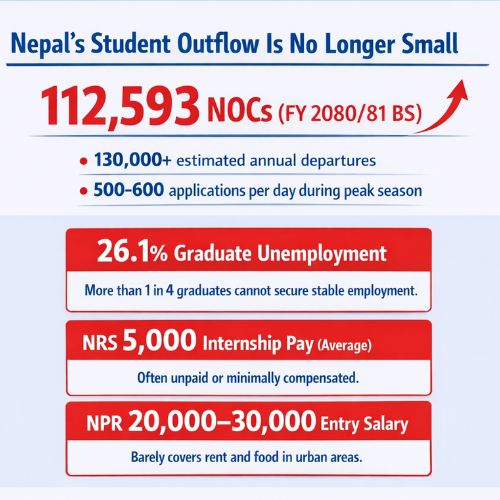
This reflects a structural shift, not a temporary trend. And here is why most of the Nepalese students are choosing abroad for their next academic journey:
Economic Pressure at Home
Graduate unemployment in Nepal stands at 26.1 percent. This means more than one in four university graduates struggle to secure stable employment.
Without a stable source of income, many graduates find themselves facing a difficult and often uncomfortable decision. The choice usually comes down to two paths: trying to gain experience through internships or arranging loans to study abroad.
However, the reality on the ground is far more complex. In Nepal, internships rarely provide financial stability. Most positions offers a very little pay (around NRS 5,000) or no pay at all, making it difficult for young people to support themselves or their families while gaining experience. This creates a gap between what is expected and what is possible.
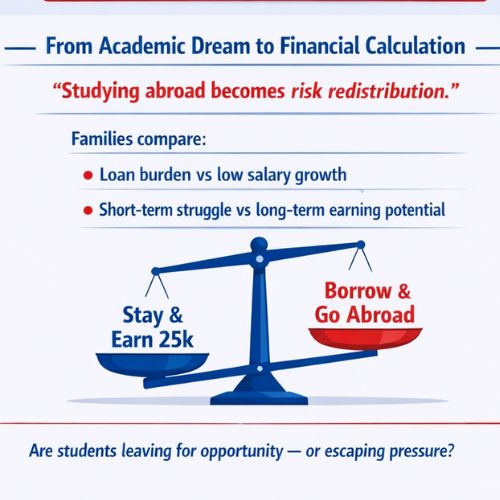
But here is what’s even more disappointing: even if someone secures an entry-level position in Nepal, entry-level salaries often range between NPR 20,000 and 30,000 per month. For families who invested lakhs in tuition fees, this return feels weak, barely enough to cover rent and food.
Under these conditions, studying abroad begins to look like financial risk redistribution rather than academic ambition.
Where Are Nepali Students Going?
The most recent completed fiscal year, 2080/81 BS (2023/24 AD), recorded 112,593 NOCs, the highest official total in Nepal’s history.
For 2081/82 BS (2024/25 AD), the first trimester alone recorded 31,768 NOCs. With daily averages reaching 600 applications, projections place the year-end total near 130,000 to 135,000 permits.
This confirms that student outflow has stabilized at a historically high level.
In 2080/81, destination breakdown was as follows:
- Japan – 34,731 students (30.8%)
- Canada – 15,982 (14.2%)
- Australia – 14,372 (12.8%)
- UK – 13,339 (11.8%)
- USA – 11,261 (10%)
Here is why people chose each of those countries:
- Japan’s dominance is linked to language school entry and transition to Specified Skilled Worker visas.
- Canada remains attractive through PGWP, leading to Express Entry PR.
- UK demand skyrocketed as Nepali student visas increased over 80 percent.
- Australia’s Subclass 485 and regional migration points influence course choice.
- The USA offers OPT and access to the H1B lottery.
These numbers show that immigration structure, not ranking, is shaping demand.y right for an individual profile.
Is Studying Abroad the Right Decision for Nepali?
If the immigration structure is shaping demand, the next step is a personal evaluation. Because what works at a national level does not automatically work at an individual level.
To determine whether this decision is right for you or not, you need to look at 4 things:
- Financial Capacity
- Academic Credibility
- Policy Changes
- Emotional Capacity
1. Financial Capacity For Nepali Students
Financial capacity is the first real filter. Before admission, before a visa interview, before a PR discussion, immigration systems look at money.
Not future earning potential. Not confidence. Not intention.
Liquid, documented funds.
For 2025–2026, Australia requires AUD 29,710 for living expenses alone. This does not include tuition. That amount must be visible and traceable.
Talking about Canada, it requires CAD 20,635 through the GIC model. The amount is locked and released in installments after arrival. Tuition for the first year is often required upfront.
The UK calculates maintenance monthly. Students must show £1,171 to £1,529 per month for up to 9 months, depending on whether they study in London or any other part of the United Kingdom.
Meanwhile, in the USA, the I-20 form reflects the total annual cost. For many institutions, financial proof ranges between $50,000 to $80,000, including tuition and living expenses.
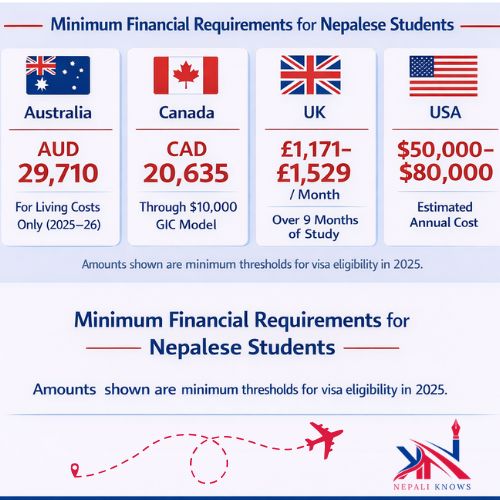
But here is what you need to remember: these are minimum thresholds. They do not represent comfortable living.
They represent eligibility.
Besides that, another important factor is liquidity stability.
If large deposits appear suddenly in bank statements without a clear history, visa officers may question the source of funds.
Education loans are acceptable in many cases, but repayment capacity must make sense relative to family income.
So before deciding to go abroad, the students should have answers to these three questions:
- Can the first year be funded without stress?
- Can the second year be sustained if part-time income falls short?
- Can loan repayment begin even if post-study work takes time?
- Is it possible to pay your loan with the part-time work?
This is important because many students calculate only the admission cost. Very few calculate survival cost.
And I know it sounds scary at first, but let me remind you that studying abroad from Nepal is not financially impossible.
But it requires more than arranging funds for a visa. It requires sustainable liquidity.
Academic Credibility For Nepali Students
After financial proof, the next filter is academic consistency. Many students believe admission is the main hurdle.
In reality, visa officers evaluate whether the academic profile logically supports the study plan.
Grades matter, but progression matters more.
A GPA around 3.0 or 75 percent is generally considered stable for competitive institutions. With a 2.5 GPA or 60 percent, applications in countries like Australia and Canada face higher scrutiny unless supported by relevant work experience.
In addition to that, large academic gaps without explanation increase risk.
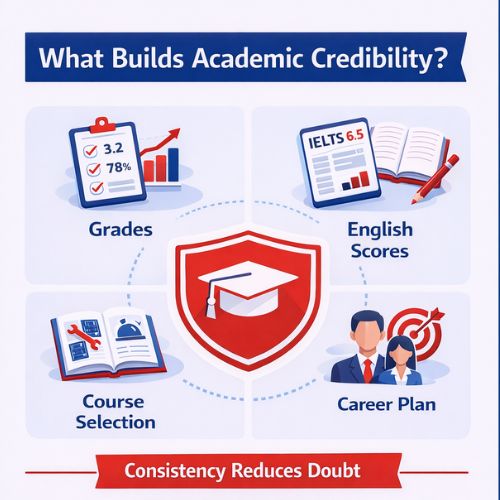
Course mismatch also raises questions. For example, shifting from engineering to hospitality without a clear academic or career link may appear weak unless justified properly.
English proficiency is another credibility indicator.
IELTS 6.0 overall has become the practical minimum for visa safety in many countries. While some universities accept lower scores, immigration authorities evaluate language ability as part of a genuine student assessment.
In the USA, there is no official government IELTS minimum. However, 6.5 or above is generally safer during visa interviews. For competitive universities and scholarships, SAT scores above 1250 still strengthen applications.
So here is a brief summary of what you need to remember about academic credibility:
- Consistency between grades, English scores, course selection, and career plan builds credibility.
- Inconsistency increases doubt.
- Academic credibility is not about being perfect. It is about making sense.
When the profile aligns logically with the study goal, the risk of visa refusal reduces significantly. The next layer, however, is where many students get confused. Policy changes.
Policy Changes for Nepali Students
Even if financial capacity is strong and academic credibility makes sense, approval still depends on policy. And policies keep on changing.
In the past, once admission was secured, visa approval felt procedural. Now it is evaluative.
Countries are managing numbers more carefully.
For example, Australia introduced the Genuine Student requirement. Officers now examine whether the chosen course logically connects with previous education and future plans. A weak academic transition can trigger refusal. PR pathways still exist, but migration points fluctuate. This means completion of a degree does not guarantee permanent residency.
Meanwhile, Canada reduced new study permits by around 35 percent for 2024–2025. Provinces now operate within capped allocations. Even with admission, applications are assessed closely for financial strength and study progression. PGWP remains available, but Express Entry cut-off scores have increased.
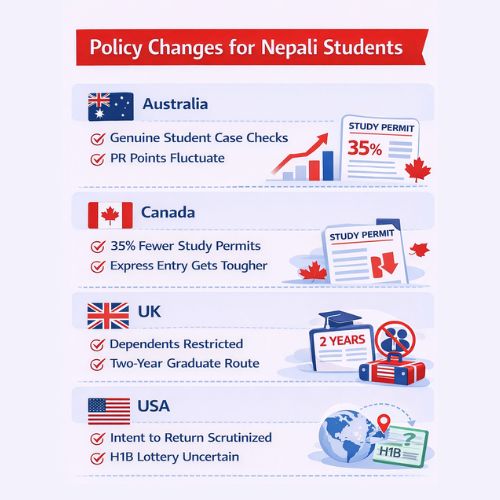
On the other hand, the UK restricts dependents for most master’s students. The Graduate Route allows two years of work, but a long-term stay requires securing a Skilled Worker sponsor. Settlement is not automatic.
And, of course, the USA continues to assess “intent to return.” OPT allows temporary work, but a long-term stay depends on the H1B lottery, which is competitive and uncertain.
Now, let’s discuss the final factor, which is often less visible but equally important. Emotional capacity.
Emotional Capacity
Emotional capacity is rarely discussed during the application. But it determines whether a student completes the journey or returns early.
Studying abroad is not only about lectures and part-time work. It is about adjustment.
Work limits are real. Australia allows 48 hours per fortnight. Canada proposes 24 hours per week. These limits mean part-time income that usually covers rent and groceries, not tuition.
Financial pressure and academic workload often overlap, and you need to be mentally prepared to deal with them.
Furthermore, you need to keep in mind that your sleep patterns change. As winter days are shorter in countries like Canada and the UK. Cultural differences can feel small at first, then heavier over time.
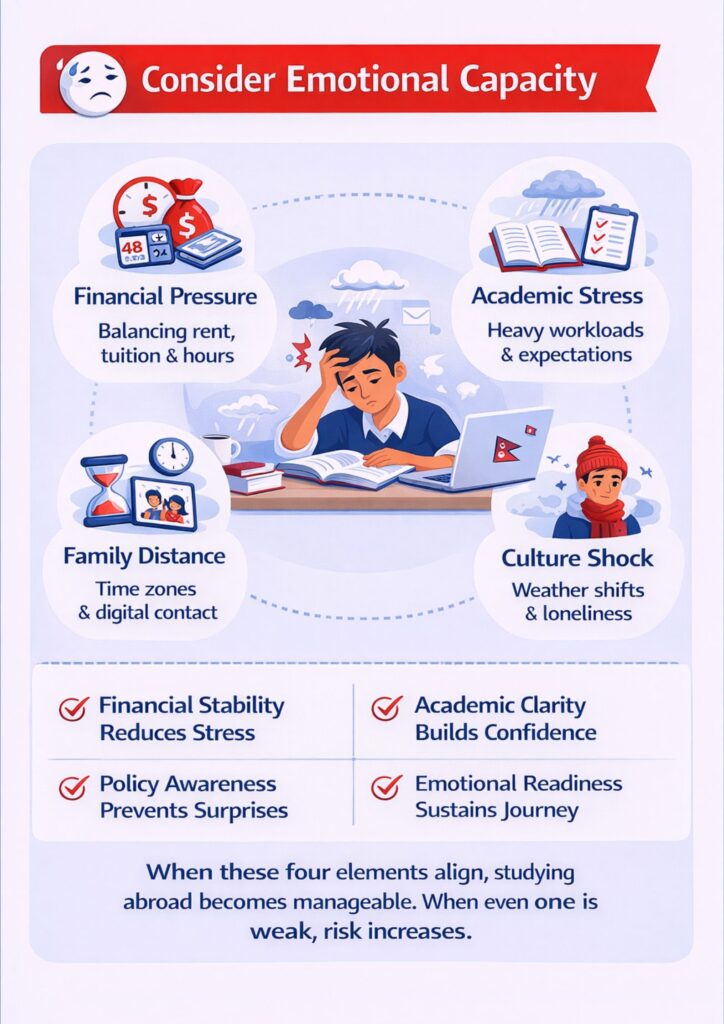
Apart from that, loneliness is common during the first year.
Family support becomes digital. Time zones reduce daily contact. Festivals are spent differently. Small routines feel unfamiliar.
Health insurance is mandatory in most countries. In Australia, OSHC must be paid upfront. In the UK, the NHS surcharge is included in the visa process. Understanding coverage takes time, and unexpected medical costs can create stress.
And here, many students think that it’s about being fearless, but it’s not. Rather, it’s about being prepared for isolation, slow progress, and uncertainty.
So here is what you need to remember:
- Financial stability reduces stress.
- Academic clarity builds confidence.
- Policy awareness prevents surprises.
- Emotional readiness sustains everything else.
When these four elements align, studying abroad becomes manageable. When even one is weak, risk increases.
The next step is not an application. The next step is choosing the country strategically.
Best Countries for Nepali Students in 2026
Once financial capacity, academic credibility, policy environment, and emotional capacity are clear, the next step becomes simpler.
Now the question is not “Which country is best?”
The question is “Which country matches the goal and risk level?”
In 2026, countries are tightening rules and raising costs. So the best country to study from Nepal is usually the one where the plan survives pressure.
Quick Comparison Table for Which Country Might Be Better
| Country | Work Limit During Term | Post Study Work | Tuition Range | Visa Climate 2026 | PR Reality |
|---|---|---|---|---|---|
| Australia | 48 hours per fortnight | 2 years course, 3 research, 4 PhD | AUD 20,000–50,000 | Tightened under GS | Difficult and occupation-based |
| Canada | 24 hours per week | Up to 3 years | CAD 15,000–45,000 | Tightened, high rejection | Possible but competitive |
| UK | 20 hours per week | 2 years, 3 PhD | £12,000–38,000 | Scrutinized, dependent ban | Long route via sponsor |
| USA | 20 hours per week on-campus | 1 year, STEM up to 3 | $25k–40k public, $40k–60k+ private | High rejection risk | Work-based, not study-based |
| Japan | 28 hours per week | 6–12 months job search, then work or SSW | 500k–1.5M JPY | Relatively stable | Language-dependent, long term |
Australia
Australia works for students who want part-time work income and a PR-focused plan.
Work is capped at 48 hours per fortnight. Post-study work under Subclass 485 is now standardized: 2 years for coursework, 3 years for research, 4 years for a PhD.
However, tuition fees have increased, with ranges around AUD 20,000–50,000, and visa scrutiny is tighter under the Genuine Student rule, especially for VET routes.
PR is possible, but it is competitive and depends on occupation, points, and often regional strategy.
Canada
Canada still attracts Nepali students because the PR pathway is structured.
Work is capped at 24 hours per week. PGWP can be up to 3 years.
Tuition is typically CAD 15,000–45,000. Visa climate is tighter due to national caps, and rejection rates spiked in 2025. The PR path is still possible, but Express Entry CRS cut-offs stay high, around 515–547 in general draws.
Canada fits students with strong financial proof and a realistic category-based PR plan.
UK
The UK fits students who want to finish fast and enter the job market quickly.
Work is 20 hours per week during the term. The Graduate Route gives 2 years after study.
Tuition ranges £12,000–38,000. The big policy change is the dependent restriction for most master’s students.
PR is not direct. It usually needs a Skilled Worker sponsor and around 5 years on that route.
USA
The USA offers strong long-term earning potential, especially in STEM.
Work is 20 hours per week on-campus during term. OPT is 1 year, and STEM can extend to 3 years total.
Tuition is expensive, especially at private universities. Visa risk is higher, with rejection reaching 36% in late 2025.
PR is not study-based. It depends on H1B and employer sponsorship, and then on the green card process.
The USA fits students with strong academics, strong funding, and a high tolerance for uncertainty.
Japan
Japan is chosen for affordability and relatively stable approvals.
Work is 28 hours per week, with proper permission. Tuition remains lower in many cases, around 500,000 to 1,500,000 JPY.
Post-study, students can stay 6 months to 1 year for job hunting, then transition to a work visa or SSW.
PR usually takes 10 years, unless someone qualifies under the Highly Skilled Professional points system.
Japan fits students who can commit to the Japanese language and long-term adaptation.
How Much Does It Cost to Study Abroad from Nepal?
After comparing countries, the next reality check is cost. Not tuition alone. Total first-year commitment.
For 2026 planning, the estimated first-year investment, including tuition and basic living expenses, looks like this:
- Australia: NPR 25–45 Lakhs ($18,500–$33,500)
- Canada: NPR 20–35 Lakhs ($15,000–$26,000)
- UK: NPR 25–40 Lakhs ($18,500–$30,000)
- USA: NPR 30–50 Lakhs ($22,000–$37,000)
- Japan: NPR 10–20 Lakhs ($7,500–$15,000)
These are not luxury estimates. They reflect moderate living and average tuition.
Japan remains the lowest entry point. The USA and Australia require the highest upfront commitment.
Government Visa and Application Cost
Before departure, non-refundable fees must be paid. Here is what those costs will look like:
- Australia’s Student Visa (Subclass 500) costs AUD 1,600, which is roughly NPR 1.45 Lakhs.
- Canada’s Study Permit costs CAD 150 plus CAD 85 biometrics, around NPR 25,000.
- The UK Student Visa costs £490, approximately NPR 85,000.
- The USA F1 visa includes a $185 MRV fee plus $350 SEVIS, around NPR 72,000.
And at the end, everyone needs to undergo medical examinations in Nepal, which usually cost NPR 15,000 to 20,000.
These are paid regardless of outcome.
Language and Test Costs In Nepal
IELTS in Nepal currently ranges from NPR 27,400 to 39,600.
PTE Academic costs around $245, roughly NPR 33,000.
GRE, if required, costs around $220, approximately NPR 30,000.
Multiple attempts increase this total.
Flights and Initial Setup
One-way flights vary by season.
- Australia ranges between NPR 90,000 to 1.5 Lakhs.
- Canada can reach NPR 1.2 to 2 Lakhs.
- The USA ranges between NPR 1 to 1.8 Lakhs.
- Japan remains lower at NPR 60,000 to 1 Lakh.
Upon arrival, most cities require one month’s rent plus one month’s deposit. In Western countries, that can mean $1,000 to $2,500 upfront.
Hidden Financial Commitments
Canada requires a CAD 20,635 GIC deposit before visa approval.
The UK charges an NHS surcharge of £776 per year. On the other hand, Australia requires OSHC insurance, usually AUD 700 to 1,200 annually.
Besides that, documentation, translation, WES, and courier can add another NPR 10,000 to 30,000.
When families calculate only tuition, they underestimate pressure.
The real first-year cost is always higher than the admission letter suggests.
IELTS, PTE and Language Requirements Explained
After cost, the next major filter is language.
Many students treat IELTS as a formality.
Immigration departments do not.
There is a difference between the admission minimum and the visa-safe score. Mixing these two creates unnecessary rejection risk.
Admission Minimum vs Visa-Safe Score
Universities often publish lower English requirements.
Visa officers look at overall credibility.
For 2026:
- Australia now requires a minimum IELTS 6.0 overall for student visa eligibility. Anything lower is high risk.
- Canada requires 6.0 in each band under SDS. Non-SDS applications face higher scrutiny.
- UK allows 5.5 for degree level in some cases, but most competitive programs expect 6.0 or higher.
- USA has no official government minimum, but 6.5 or above is considered safer for visa interviews.
- Japan usually requires 6.0+ for English programs. Japanese language programs require N2 or N1 for long-term advantage.
Admission does not equal visa approval.
A lower score may secure an offer letter but increase the refusal risk during visa review.
IELTS vs PTE vs Duolingo
IELTS Academic remains the most widely accepted test.
PTE Academic is accepted in Australia, Canada, the UK, and many US institutions. It is computer-based and often preferred by students comfortable with technology.
Duolingo gained popularity during the pandemic. However, visa acceptance is inconsistent. Many immigration departments still prioritize IELTS or PTE.
For higher visa safety, IELTS or PTE remains a stronger choice.
Retake Strategy
Multiple test attempts are common. But repeated low scores without improvement weaken credibility.
It is usually better to delay the application and improve the score than to rush with borderline results.
Language score is not just about admission. It signals the preparation level.
The next major filter is the visa itself.
Let’s look at the reality of student visas for Nepali applicants in 2026.
Student Visa Reality Check for Nepali Students
After cost and language requirements, the final filter is the visa.
And in 2026, this filter will be stricter than before.
The global visa environment has shifted from volume-based approvals to integrity-focused screening. Countries are not just processing applications. They are evaluating intent, financial strength, and consistency.
Rejection Rates Are No Longer Low
For Nepali applicants, the numbers are serious.
Australia’s student visa rejection rate for Nepali applicants is estimated around 40 percent, with Nepal categorized under Assessment Level 3, meaning higher scrutiny.
Canada recorded a rejection rate of around 62 percent in 2025, the highest in over a decade, largely due to national study permit caps.
The USA saw F-1 rejection rates rise to roughly 36 to 41 percent in late 2025.
The UK remains more stable, with refusal rates generally between 5 to 11 percent, though compliance monitoring has tightened.
Japan continues to show relatively high approval rates, often above 90 percent, for applicants with clear documentation and financial proof.
These figures show one pattern. Approval is no longer assumed.
Why Applications Get Refused
In Australia, many refusals are linked to the Genuine Student requirement, especially in vocational sectors. Course mismatch and unexplained academic gaps trigger rejection.
In Canada, refusals frequently cite insufficient tuition proof or weak living expense documentation. Study plan mismatch is now a common refusal reason.
In the USA, Section 214(b) remains the main ground for denial. Officers must be convinced the applicant intends to return home.
In the UK, many refusals result from documentation errors or incorrect visa categories.
Most refusals are not random. They are traceable to visible gaps.
Processing Time and Cost Reality
Australia now charges AUD 2,000 for a student visa, making it the most expensive globally. Processing typically takes 4 to 8 weeks.
Canada processing times fluctuate after permit caps. SDS may be faster, but standard streams face delays.
The UK usually processes within three weeks.
Japan requires 2 to 3 months for Certificate of Eligibility before visa stamping.
The pattern is clear.
The 2026 cycle rewards strong documentation and logical planning. It penalizes rushed or inconsistent applications.
The next question is even more sensitive.
Is the goal education, or is it permanent residency?
That discussion needs honesty.
Scholarships & Financial Support for Nepali Students
After understanding cost and PR reality, the next question becomes simple.
Can scholarships reduce the financial burden?
The short answer is yes. The honest answer is not for most applicants.
Merit-Based Scholarships
Many universities offer partial tuition scholarships.
These are usually:
- 10 to 30 percent tuition reduction
- Based on GPA and IELTS
- Automatically considered during admission
For example, in Australia and the UK, scholarships are often tied to academic excellence. In Canada and the USA, competitive scholarships may require stronger academic profiles and sometimes leadership or extracurricular evidence.
A GPA above 3.0 or 75 percent improves eligibility.
However, partial scholarships rarely cover living expenses.
Government Scholarships
Fully funded scholarships exist.
Examples include:
- Australia Awards
- Chevening (UK)
- Fulbright (USA)
These cover tuition, living expenses, and travel.
But competition is intense and acceptance rates are extremely low.
Applicants usually need strong academic records, leadership experience, and clear long-term career impact plans.
These are not mass-access options.
Assistantships (USA Focused)
In the USA, graduate students may receive:
- Tuition waivers
- Teaching assistantships
- Research assistantships
These reduce tuition fees significantly and may provide monthly stipends.
However, assistantships are more common at the Master’s research or PhD level, not undergraduate.
Admission to such programs is competitive.
What Most Students Misunderstand
Many believe applying to more universities increases full funding chances.
In reality, full ride scholarships for Nepali students are rare and highly competitive.
Most state colleges in the USA do not offer full funding to international undergraduate students.
Private colleges may offer more aid, but acceptance rates are low.
Practical Financial Strategy
For most Nepali students in 2026:
- Plan assuming no full ride
- Treat scholarships as a bonus
- Secure stable financial backing first
- Apply early for merit reductions
Scholarship planning reduces cost.
It does not eliminate risk.
The next question becomes strategic.
Should the application be handled through a consultancy or independently?
Let’s examine that carefully.
Common Mistakes Nepali Students Make Before Going Abroad
After going through cost, visa reality, and PR discussions, a pattern becomes visible.
Most problems do not begin abroad.
They begin before departure.
The first mistake is choosing a country based on momentum instead of profile. When Canada tightens, students move to Australia. When Australia tightens, they shift to the UK or Japan. The decision becomes reactive. But immigration policy reacts faster than students do. A country that looks easy this year may look different next year.
The second mistake is calculating affordability based only on tuition. Families look at the admission letter and assume the hardest part is over. Then GIC, health insurance, visa fees, deposits, and exchange rate fluctuations slowly increase pressure. Financial stress rarely appears in the first month. It builds over time.
Another quiet mistake is academic mismatch. Changing fields without a clear career bridge may secure admission, but it weakens visa credibility and long-term employability. Immigration officers evaluate logic, not just eligibility.
There is also the PR shortcut assumption. Many students choose courses only because they appear on migration lists. But migration lists change. Cut-off points change. When PR becomes uncertain, motivation drops.
The final mistake is emotional underestimation. Documents are prepared carefully. Mental preparation is ignored. Work limits are real. Social isolation is real. Adaptation takes longer than expected.
None of these mistakes are dramatic.
They are gradual. And that is why they are dangerous.
What You Should Do Before Deciding to Study Abroad
After reviewing costs, visa risks, PR reality, and common mistakes, one thing becomes clear.
The decision should not start with the application.
It should start with an evaluation.
Before committing to study abroad from Nepal, speak to at least two alumni currently living in that country. Not agents. Not promotional pages. Real students. Ask them about rent, workload, part time income, and stress level.
Then calculate first-year cost again. This time, include tuition, visa fee, insurance, flight, rent deposit, and emergency buffer. If the plan depends entirely on part time work to survive, the risk is already high.
Next, match the course with a realistic career outcome. Look at job demand in that country, not only migration lists. Ask whether the degree builds a skill that remains valuable even if PR becomes difficult.
Also check visa rules directly from official government websites. Do not rely on screenshots or short videos. Policies change faster than social media updates.
Finally, evaluate return on investment honestly. If the total commitment is NPR 35 to 40 lakhs, what is the expected income after graduation? How long would it take to recover the cost?
This is not about fear.
It is about clarity.
When the decision survives this level of questioning, it becomes stronger. And if you have already decided, we recommend you read our step-by-step guide to studying abroad from Nepal.
Frequently Asked Questions
Which country is best for Nepali students?
There is no universal best country. The right choice depends on financial capacity, academic strength, and long-term goals. Canada offers structured PR pathways but is competitive. Australia is migration-focused but costly. The USA offers strong career ROI with higher visa risk. Japan is affordable but language-dependent.
How much money is required to study abroad from Nepal?
In 2026, the first-year investment typically ranges between NPR 20 to 45 lakhs for major Western destinations. Japan may range between NPR 10 to 20 lakhs. This includes tuition and basic living expenses but not luxury spending.
Can I study abroad with low GPA?
It depends on the country and program. A GPA below 2.5 increases visa scrutiny in countries like Australia and Canada. Course logic and English proficiency become even more important in such cases.
Is IELTS compulsory?
Most countries require proof of English proficiency. IELTS or PTE is widely accepted. Some universities accept alternatives, but for visa safety, IELTS 6.0 or above is generally safer.
Is PR guaranteed after study?
No. Permanent residency is never guaranteed. It depends on job market conditions, immigration policy, occupation demand, and competition at the time of application.

Bishad Kandel has been writing for the past three years across different niches, combining creativity with research-driven insights. With a degree in Information Technology, he brings a strong background in data analysis to his work, ensuring every blog he writes is factual, engaging, and meaningful. His approach blends storytelling with evidence, making complex topics easier to understand for readers.