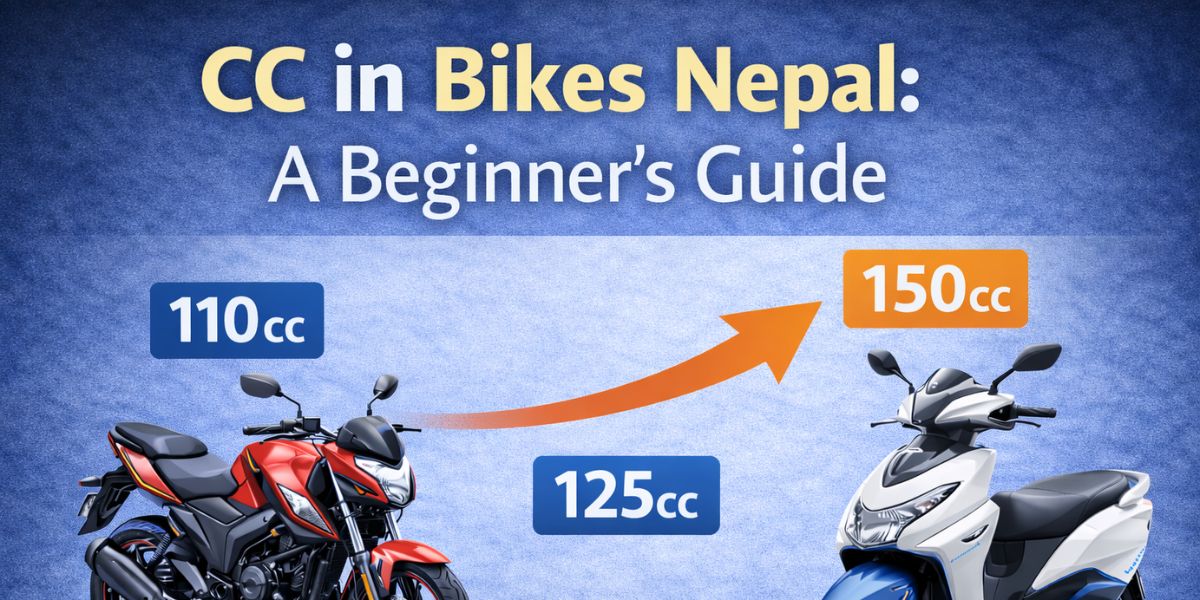
When someone in Nepal plans to buy a bike, one of the first questions they hear is, “How many CC do you want?” or in Nepali, “Kati CC ko bike line bhaiyo ta?“
Some of them will suggest 110cc is enough. Others would recommend you go for a 125cc. And a few will proudly tell you that 150cc is the best choice.
But very few buyers actually understand what that number means in real life.
If you are new to bikes, do not worry. Let us break this down slowly and clearly.
What Is CC In Bikes in Simple Words?
CC means the size of the engine. That is all you need to remember. If you are really into full forms, then it stands for Cubic Centimeters.
Think of the engine like a small pump inside the bike. The bigger the pump, the more fuel it can burn at one time. When it burns more fuel, it produces more power.
But when it produces more power, it also consumes more petrol.
So higher CC means more power and usually more fuel use. Lower CC means less power and better fuel efficiency.
It is like cooking with a bigger gas flame. You can cook faster, but you also use more gas.
Why do bigger CC bikes sound attractive in Nepal?
Many young bikers in Nepal think that a higher CC means a stronger bike. They believe it will feel faster and more powerful. And yes, technically, it is stronger.
But the real question is not how powerful it is. The real question is whether you actually need that extra power.
Let us imagine two people.
The first person lives in Lalitpur and rides 12 kilometers daily to the office or college. His ride includes traffic signals, buses, and slow-moving roads. Most of the time, he is moving slowly.
For him, even a 110cc scooter is enough. He will not use the full power of a 150cc engine because the road does not allow it.
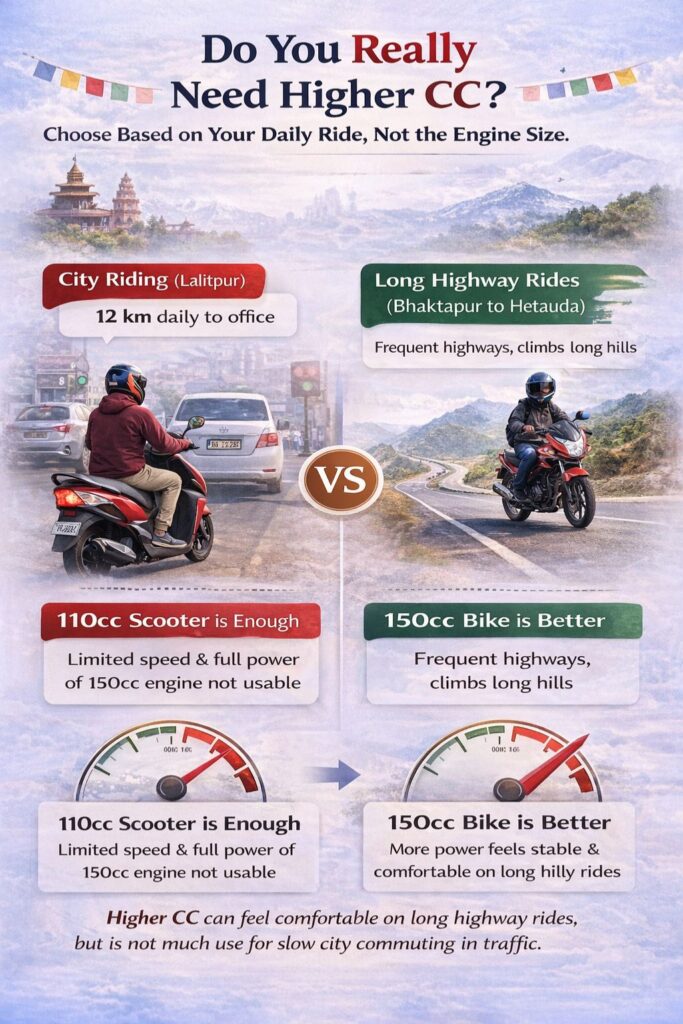
Now imagine someone who rides from Bhaktapur to Hetauda every week. He uses highway roads and sometimes climbs long hills. In this case, slightly higher CC can feel more comfortable.
The engine does not feel stressed during long uphill climbs. So the usefulness of CC depends on how and where you ride.
How CC Affects Mileage in Nepal?
Mileage is the most important word for Nepali buyers.
In simple terms, mileage means how many kilometers your bike runs in one litre of petrol.
Now, let us look at practical numbers.
A 110cc scooter in Kathmandu traffic may give around 45 to 55 kilometers per litre.
A 125cc bike may give around 55 to 62 kilometers per litre.
A 150cc bike may give around 35 to 45 kilometers per litre.
Now think about the petrol price. If petrol averages around NPR 160 per litre over the coming years, the difference in mileage becomes important.
If you ride 25 kilometers every day, the fuel cost difference between a 125cc and a 150cc bike may seem small at first. But when you calculate it over one year, and then over five years, the total difference becomes large.
And here is an important part: Fuel is something you pay for every week. So CC directly affects your monthly budget.
City Traffic and Daily Travel Reality For Nepalese
Kathmandu traffic is slow and crowded. Most of the time, you are stopping and starting. You rarely ride at very high speeds.
In this condition, smaller engines work very well. They are lighter, easier to handle, and more fuel-efficient.
If your daily use is office, college, market, and short city trips, a 110cc or 125cc is usually more than enough.
Buying a 150cc for heavy traffic is like buying a large truck to carry two grocery bags. It works, but it is not practical, right?
Which CC Bikes Are Better For Highway and Hilly Areas Of Nepal?
Now let us talk about hill roads and highways.
In Nepal, many roads include steep climbs. If you often ride with a partner and sometimes carry an extra load, a slightly higher CC can feel smoother.
For example, if you regularly travel long distances between cities, a 125cc can offer better comfort compared to a 110cc.
But many people overestimate their need. They think they need 150cc for an occasional highway ride. In reality, 125cc bikes in Nepal handle highways and hills quite comfortably for normal use.
So the decision should be based on how often you ride long distances, not once or twice a year.
Insurance, Maintenance, and Resale
Higher CC bikes usually have a higher insured value. That means a slightly higher insurance premium each year.
Some spare parts may also cost more. Over five years, this adds to the total ownership cost.
The resale market in Nepal is very strong for 110cc scooters and 125cc bikes. These segments are popular because they are practical and affordable. Furthermore, ever since the arrival of ride-sharing platforms like Pathao and InDrive, 110cc two wheelers have become more popular because it is more effecient for the drivers.
This is why, if you plan to sell after three or four years, choosing a practical CC makes resale easier.
The Most Common Mistake Related To CC in Nepal
One common mistake is choosing CC based on what friends say.
A friend may say, “150cc feels powerful.”
But after some months, the buyer realizes that petrol costs more, and the extra power is rarely used.
Buying a bike is not about showing power. It is about matching engine size to your daily routine and budget.
So Which CC Should You Choose?
If you are a beginner rider and mostly ride inside the city, a 110cc or 125cc is usually the smartest choice.
If you ride mixed city and highway regularly, a 125cc is a very safe balance.
If you ride long highway distances very frequently and want stronger performance, then a 150cc may make sense.
But remember, higher CC means higher running cost.
The right CC is the one that fits your daily life, not your ego.
If you want to understand how CC also affects loan amount, insurance cost, and five-year ownership cost in Nepal, you can read our complete buying guide for bikes and scooters in Nepal, where everything is explained step by step.
Frequently Asked Questions
What is CC in bike Nepal in simple words?
CC means the size of the engine. A bigger CC engine can burn more fuel and produce more power. But it also usually consumes more petrol. Smaller CC engines produce less power but give better mileage. So CC directly affects both performance and fuel cost.
Is higher CC always better in Nepal?
No. Higher CC is only better if you actually need more power. In heavy Kathmandu traffic, most riders do not use the full power of a 150cc engine. For daily office or college commuting, a 110cc or 125cc is usually more practical and fuel-efficient.
Which bike CC is best for Nepal?
For most Nepali riders, 125cc is the safest balance. It gives good mileage, enough power for city and highway, and strong resale value. If your use is only for short city travel, 110cc is also very practical. 150cc makes sense mainly for frequent highway riding.
110cc vs 125cc in Nepal – which one should I choose?
If you mostly ride inside the city and want lower petrol costs, a 110cc scooter is enough. If you want slightly better power for mixed city and occasional highway use, a 125cc bike is a better balance. The difference is not huge, but a 125cc usually feels more stable at higher speeds.
Does higher CC mean lower mileage?
In most cases, yes. Higher CC engines consume more fuel because they are designed to produce more power. In Nepal’s stop-and-go traffic, this difference becomes noticeable over time. That is why smaller CC bikes often give better real mileage.
Does CC affect insurance costs in Nepal?
Yes. Higher CC bikes usually have a higher insured value. That means a slightly higher insurance premium every year. It may not look big in one year, but over five years it adds up.
Does CC affect resale value?
Yes, but in a practical way. In Nepal, 110cc and 125cc bikes and scooters are easier to sell because more buyers are looking for them. Higher CC bikes have resale value, too, but the buyer group is smaller.
Should a beginner buy a 150cc bike in Nepal?
If you are new to riding and mostly use the bike inside the city, starting with a 125cc is usually safer and more practical. It delivers enough power without unnecessarily increasing petrol and maintenance costs.

Bishad Kandel has been writing for the past three years across different niches, combining creativity with research-driven insights. With a degree in Information Technology, he brings a strong background in data analysis to his work, ensuring every blog he writes is factual, engaging, and meaningful. His approach blends storytelling with evidence, making complex topics easier to understand for readers.