In 2026, studying abroad from Nepal is no longer just about qualifying. It is about convincing first the university and then your visa officer that you are a genuine student.
In fact, there is a vast difference between paper and in the field that every Nepali applicant should know about.
For example, on paper, 60 percent may still appear as the minimum for many Bachelor’s programs. But in reality, 65 percent or a 3.0 GPA now sits in the safer zone.
Meanwhile, for Master’s degrees, 60 to 65 percent may technically qualify, but 70 percent or above significantly strengthens both admission and visa credibility. And yes, backlogs matter too. Five may still pass at standard universities, but repeated failures in core subjects quietly weaken your case.

Talking about your IELTS, it follows the same pattern. IELTS 6.0 remains the official minimum, yet 6.5 has become the practical benchmark, with 7.0 required for competitive programs like Nursing and Research.
Regarding finance, government rules require students to show a minimum amount of money, such as AUD 29,710 for Australia or CAD 20,635 for Canada. These figures are meant to cover basic living costs.
However, in today’s reality, most Nepali students need closer to around NPR 40 lakhs to feel financially secure. This includes tuition, living expenses, emergencies, and currency changes for a year. If your budget is lower than this, it does not mean studying abroad is impossible. But it does mean you must plan more carefully, choose affordable options, and avoid financial risks.
But only understanding this much won’t help someone to apply to study abroad from Nepal. So, here is a step-by-step guide to give you guys a clear idea of how to study abroad from Nepal.
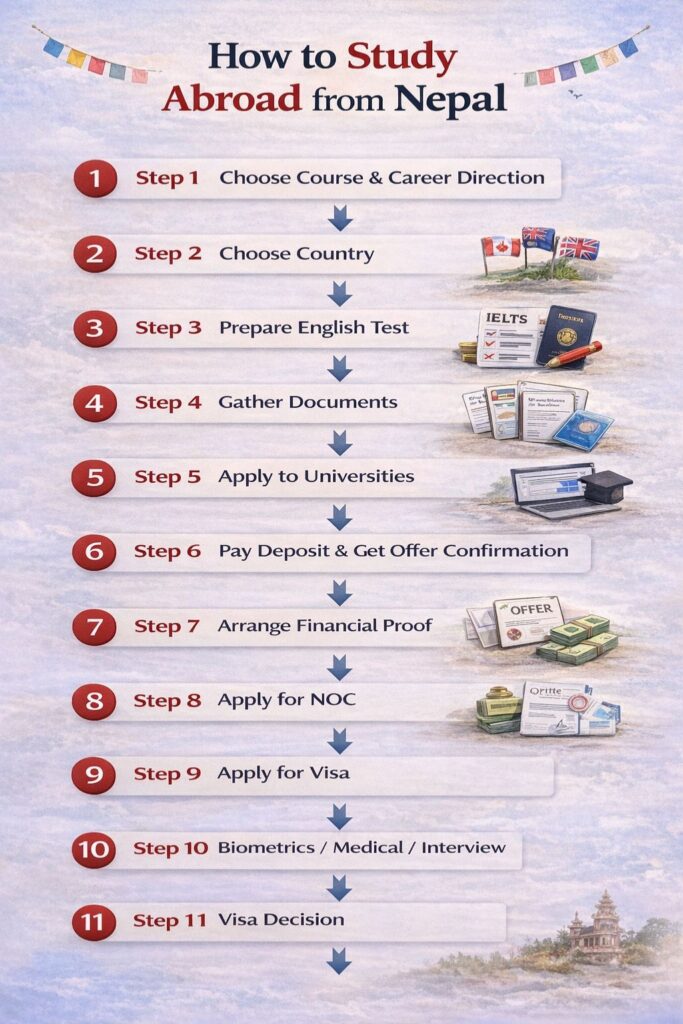
Step 1: Decide Your Course and Career Direction
Remember, a few years back, students could select almost any diploma or degree and hope to “figure it out” later. But now that flexibility has narrowed. As, immigration systems now study course choice carefully. Universities evaluate academic progression. Visa officers question sudden shifts.
The question is no longer “What do I want to study?” It is “Does this choice make long-term sense?”
Furthermore, in countries such as Australia, Canada, and even the United States, the path to permanent residency (PR) is closely tied to workforce shortages. This means if your choice is general degrees without labour demand, chances are you are going to face difficulty in transitioning into residency.
Just take Australia as an example: high-demand professions in healthcare, aged care, early childhood education, and construction trades still give you the highest chances of getting PR. In fact, compared to IT professionals, nursing applicants often receive invitations at lower point thresholds.
Besides that, if your main goal is to get PR quickly, then the region you are studying in also matters a lot, as studying in designated regional areas provides five additional migration points under the points-tested system in Australia.
Similar to Australia, Canada has moved toward category-based draws as well. Healthcare, STEM, trade occupations, and French proficiency are currently prioritized. Master’s graduates benefit from a three-year post-graduation work permit regardless of program length. Diploma students, however, must ensure their field appears on the 2026 PGWP eligible list. Random enrollment into unrelated certificates is increasingly risky.
This is where many Nepali students miscalculate.
A BBS graduate suddenly shifting into a Master’s in IT without a technical background often struggles to justify the change. A Science student applying for a Cookery diploma may be flagged as seeking work rights rather than education. An Engineering graduate moving into a hospitality diploma faces similar difficulty.
Immigration officers are trained to ask one simple question: Is this academic progression logical?. This means that at any given moment, you must be able to answer or provide logic for why all of a sudden you decided to change your field of study.
But if you ask us, our suggestion would always be that a healthcare-focused student should pursue healthcare. A technically inclined student should remain within STEM progression. A business graduate can logically transition into analytics or management specialization, but must justify the academic bridge.
We say this because studying abroad is an investment that can cross NPR 40 lakhs in the first year alone. The chosen course becomes the foundation for that investment.
And in the current immigration climate, clarity is more powerful than trend-following.
Once the course direction is clear, the next decision becomes equally critical. Which country supports that direction best?
Step 2: Choose the Right Country
Once the course direction becomes clear, the bigger question quietly follows.
Where should this journey actually happen?
In Nepal, country choice often begins with influence. A cousin in Sydney. A friend in Toronto. A TikTok video from London. A scholarship story from Texas. All of these become the major reasons for the choice of country.
But in 2026, you need to understand that your right fit shouldn’t necessarily come from influence. Rather, it should be based on your fit.
Australia, for example, remains structured but demanding. The student visa now costs AUD 1,600. Living cost proof stands at AUD 29,710, even before tuition is counted. Work is limited to 48 hours per fortnight during term.
The Genuine Student requirement has made academic progression more important than ever. Regional study still gives five migration points, yet PR invitations in popular occupations often require around 90 points or more. Australia rewards clear planning, but it does not forgive inconsistency.
On the other hand, Canada feels systematic, but financially heavier. The GIC alone requires CAD 20,635, locked before approval. Students can work 24 hours per week. Master’s graduates benefit from a three-year post-study work permit, but diploma pathways are now field-restricted. Express Entry cutoffs frequently sit between 500 and 550 CRS points. Canada offers structure, yet entry has become selective.
Similarly, the United Kingdom feels shorter and more direct. Visa fees approach £524, with an additional £776 per year for the health surcharge. Maintenance proof depends on location, reaching £1,529 per month in London. Work rights remain capped at 20 hours weekly. The Graduate Route allows two years after most degrees. It is predictable, but long-term settlement requires transition into a Skilled Worker pathway.
On the other hand, the United States remains powerful but interview-driven. The SEVIS fee is $350, the visa fee is $185, and the I-20 financial proof often ranges between $50,000 and $80,000. Work is restricted to campus roles initially.
Rejection rates for Nepali applicants have fluctuated between 30 and 50 percent in recent cycles. Approval depends as much on clarity as on documentation.
Japan, meanwhile, stands quieter. Tuition often ranges between 700,000 and 900,000 yen annually. Work rights extend to 28 hours per week. Long-term residency requires patience, often ten years, unless qualified under skilled categories. It is affordable, but language commitment is non-negotiable.
You see, each country offers an opportunity. Each carries risk. The decision is not about which country sounds impressive.
It is about which system best aligns with academic background, financial strength, and long-term stability.
Now we move forward. English testing becomes the next gate.
Step 3: Prepare for IELTS or English Test
Before admission letters and visa files, one document quietly shapes credibility. English proficiency.
In Nepal, IELTS Academic costs NPR 33,000 for computer-based and NPR 36,200 for paper-based. UKVI versions cost NPR 36,400 to NPR 39,600. Computer results arrive in 3 to 5 days, paper in 13 days. Scores remain valid for 2 years. One Skill Retake is available for computer tests at NPR 16,500. Enquiry on Results costs roughly NPR 11,000 to 16,000 and is refunded if bands increase.
| Country | Safe IELTS Benchmark 2026 |
|---|---|
| Australia | 6.5 overall, 7.0 for Nursing |
| Canada SDS | 6.0 each band, 6.5 safer |
| UK | 6.0 minimum, 6.5 competitive |
| USA | 6.5 typical, 7.0 research |
| Alternative Test | Nepal Fee Range |
|---|---|
| PTE Academic | NPR 27,000 to 30,000 |
| TOEFL iBT | NPR 28,000 to 31,000 |
Coaching in Nepal averages NPR 7,000 to 15,000. Minimums may qualify. Margin protects.
Step 4: Gather Academic and Personal Documents
At this stage, your application stops being a dream and starts becoming evidence.
Universities and visa officers do not see your potential first. They see your documents. And in 2026, documentation is no longer a formality. It is credibility.
If you are applying for a Bachelor’s degree, you will need your SEE certificate, Grade 11 and 12 transcripts, character certificates, and provisional certificates if your final one is not yet issued.
Meanwhile, for a Master’s degree, a Bachelor’s transcript covering all semesters is essential, along with your graduation and provisional certificates. Most Master’s programs require two academic Letters of Recommendation. Besides that, a CV becomes important if you have a study gap of two years or more because gaps must show some kind of progression.
At the university stage, scanned copies are acceptable. But at the visa stage, notarized copies are required. If any document, such as a citizenship or birth certificate, is in Nepali, a certified English translation is mandatory.
Then comes compliance. A Police Clearance Certificate must be obtained through the Nepal Police OPCR portal and usually takes 2 to 3 working days.
After that, you need to prepare a document to prove you are healthy. Medical requirements vary by country. Australia requires eMedical before or during the visa application. Canada recommends upfront medical for SDS applicants. The UK mandates a TB test before visa submission. The USA does not require a pre-visit visa medical, but universities require immunization records before enrollment.
This is where many files weaken. Not because students are unqualified, but because paperwork lacks structure. In 2026, under Genuine Student and stricter Study Permit reviews, disorganized documentation is interpreted as disorganized intent.
Step 5: Shortlist Universities and Apply
This is where your research becomes serious.
Many Nepali students choose a university solely based on consultancy recommendations. But in 2026, independent verification is not optional. It is protection.
Start with official university websites. Every university publishes its entry requirements on its international admissions page. If you are unsure where to begin, platforms like QS World University Rankings and Times Higher Education help compare global rankings. For tuition estimates and course comparisons, MastersPortal and BachelorsPortal provide side-by-side filters by country, tuition range, and duration.
For Australia, check the CRICOS code validation through the Australian Government website to confirm a course is legally approved for student visas. For Canada, use the DLI list on the IRCC website to confirm the institution is authorized to host international students. For the USA, confirm SEVP certification through the ICE website.
Application fees typically range from AUD 50 to 150, CAD 100 to 200, GBP 20 to 75, or USD 50 to 100, depending on the country and institution.
After submission, you may receive a conditional offer if IELTS or final transcripts are pending. An unconditional offer confirms full eligibility.
Step 6: Receive Offer Letter and Pay Tuition Deposit
When your offer letter arrives, it feels like confirmation. But in reality, it is the beginning of financial verification.
There are two types of offers. A conditional offer means you still need to submit missing documents, such as IELTS results, final transcripts, or backlog clarifications. An unconditional offer confirms you have met all academic and English requirements.
To move forward, most universities require a tuition deposit. In Australia, this deposit is required before a Confirmation of Enrolment is issued. The COE is mandatory for the Subclass 500 visa application.
In the UK, universities issue a CAS letter after deposit payment and financial checks. In Canada, colleges and universities issue a Letter of Acceptance, and tuition payment strengthens visa credibility under SDS. In the USA, payment confirmation allows the university to issue the I 20, which is required before paying the SEVIS fee and booking a visa interview.
Deposit amounts vary. Some institutions require one semester’s tuition. Others may request 30 to 50 percent of the first year.
Refund policies differ by country and university. If a visa is refused, most institutions refund tuition after deducting an administrative charge, provided the refusal evidence is submitted within the deadline.
This is the first irreversible financial step. In 2026, students should read refund clauses carefully before transferring money.
Step 7: Arrange Financial Documents
In 2026, visa approval is no longer about minimum money. It is about financial clarity.
Every country now sets two numbers. The official requirement. And the realistic expectation.
For Australia, students must show AUD 29,710 for living costs alone, plus first-year tuition and travel. For Canada, the GIC requirement is CAD 20,635, in addition to first year tuition. The UK requires maintenance funds of £1,529 per month for London and £1,171 per month outside London, calculated for up to nine months. The USA typically requires proof shown on the I-20 form, often ranging between 50,000 and 80,000 USD, including tuition and living.
In Nepal, this means maintaining a consistent six-month bank history. Sudden deposits without a clear source explanation are high risk. Acceptable sponsors usually include parents, legal guardians, or close blood relatives. Income documents such as tax returns, salary certificates, business registration, and bank statements must align logically.
Education loans are accepted, but repayment capacity is reviewed indirectly through family income stability.
In practical terms, most successful 2026 applicants demonstrate liquidity close to NPR 40 lakhs or more when targeting Australia, Canada, the UK, or the USA.
This stage is not about showing wealth. It is about showing stability.
Step 8: Apply for No Objection Certificate NOC
For Nepali students, the study abroad process is incomplete without the NOC.
The No Objection Certificate is issued by the Ministry of Education and is mandatory for transferring tuition fees legally through Nepali banks. Without it, banks will not release foreign currency.
In 2026, the NOC process is primarily online through the official NOC portal. You must upload your offer letter, passport, academic transcripts, and tuition invoice. After online submission, biometric verification is done physically at the Ministry office.
The processing time usually ranges from 2 to 5 working days if documents are complete.
NOC is not a visa requirement from foreign governments. It is a legal requirement in Nepal. Missing or incorrect NOC documentation can delay tuition transfer and visa timelines.
Step 9: Apply for a Student Visa
Once finances and documents are ready, the visa application begins.
For Australia, applications are submitted through ImmiAccount under Subclass 500. A Genuine Student statement is required. Biometrics and medical are part of the process.
For Canada, applications are filed through the IRCC portal. SDS applicants must include GIC proof and upfront medical confirmation.
For the UK, you apply online after receiving your CAS letter and pay the Immigration Health Surcharge before booking biometrics.
For the USA, you complete DS 160, pay the SEVIS fee of 350 USD, then schedule your embassy interview.
Processing timelines vary. Australia and the UK typically take 4 to 8 weeks. Canada may fluctuate due to permit caps. US interview wait times can extend 3 to 6 months in peak seasons.
Step 10: Biometrics, Medical, and Interview
This stage verifies identity and intent.
Biometrics involve fingerprint and photograph collection at designated visa centers. It is mandatory for Australia, Canada, and the UK. The USA collects biometrics at the embassy during the interview.
Medical examinations must be done at panel physician clinics approved by each country. Australia requires eMedical submission. Canada strongly recommends upfront medical for SDS. The UK mandates a TB test before a visa application.
The US does not require pre visa medical but focuses heavily on the interview. Officers assess academic progression, financial clarity, and post-study intent.
Many refusals happen here, not due to weak academics but unclear answers or inconsistent documentation. Confidence must match paperwork.
Step 11: Visa Decision and Passport Collection
After submission, the waiting period begins.
Approval timelines vary by country and intake season. Australia and the UK often respond within one month. Canada processing may extend depending on the study permit caps. US decisions are usually immediate after an interview, but administrative processing can delay passports.
Once approved, visa conditions must be reviewed carefully. Work hour limits, course duration validity, and travel conditions are specified clearly.
For example, Australia allows 48 hours per fortnight during term. Canada allows 24 hours per week. The UK and the USA permit 20 hours during academic sessions.
This stage confirms legal entry, but responsibilities are attached. Understanding conditions avoids future compliance issues.
Step 12: Pre-Departure Preparation
Approval is not the end. It is preparation time.
Students must arrange accommodation before arrival. University dormitories fill quickly, so early booking is recommended. Private rentals require deposit payments, often equivalent to one month’s rent.
Flight booking should be done after visa approval. Forex cards or international debit cards are safer than carrying large amounts of cash.
Health insurance activation is mandatory. Australia requires OSHC. The UK activates the NHS after the IHS payment. Canada provides provincial health coverage after waiting periods.
Essential documents should be carried in physical and digital copies. This includes an offer letter, a visa grant notice, financial proof, and vaccination records.
Prepared students settle faster and avoid unnecessary stress during the first weeks abroad.
Step 13: After Arrival Responsibilities
Landing abroad is not the final step. It is the beginning of compliance.
Students must complete university enrollment within the deadline mentioned in their offer. In Australia, you must apply for a Tax File Number to work legally. In Canada, you apply for a Social Insurance Number. In the UK, a National Insurance Number is required for employment.
Opening a bank account is essential within the first week. Local SIM activation helps with official communication.
Part-time job search should begin only after academic orientation. Governments now strictly monitor attendance and academic progress.
The first 90 days determine long-term stability. Responsible integration protects both visa status and future migration pathways.
The Real Decision Behind Studying Abroad From Nepal
Studying abroad from Nepal in 2026 is no longer a casual decision. It is a structured process that demands academic readiness, financial clarity, legal compliance, and emotional stability.
From choosing the right course to securing an offer letter, arranging funds, applying for NOC, and navigating visa systems, each stage builds on the previous one. A weak decision early in the process often creates pressure later. A rushed course selection can trigger visa doubts. Poor financial documentation can delay approvals. Missing timelines can cost an entire intake.
At the same time, when the process is handled carefully, it becomes predictable. Students with clear academic progression, a safe English score, stable financial backing, and complete documentation continue to receive approvals across Australia, Canada, the UK, the USA, and Japan.
The real shift in 2026 is this. Studying abroad is no longer about simply getting out. It is about building a long-term pathway with logic behind every step.
When the plan is clear, the process becomes manageable.
FAQs
Is it still easy to study abroad from Nepal in 2026?
Studying abroad from Nepal is still possible in 2026, but it is no longer easy or casual. Immigration systems now focus on genuine students, academic progression, financial clarity, and long-term intent. Students who plan their course, country, and finances logically continue to receive approvals. Those who apply without a clear strategy face higher visa refusals.
What percentage is required to study abroad from Nepal?
Most universities still accept around 60 percent for many programs. However, in reality, 65 percent or above is considered safer for Bachelor’s degrees. For Master’s programs, 70 percent significantly improves both admission and visa credibility. Higher scores reduce visa risk and improve scholarship opportunities.
How many backlogs are acceptable for foreign study?
There is no universal limit, but many universities accept up to five backlogs. However, repeated failures in core subjects can weaken visa credibility. Students with backlogs should show improvement, strong English scores, and a logical course progression to strengthen their profile.
What is the minimum IELTS score for Nepali students?
The official minimum IELTS score is usually 6.0 overall. But in 2026, 6.5 has become the safer benchmark. Competitive programs such as Nursing, Research, and Healthcare often require 7.0 or higher. A higher score improves admission chances and visa approval.
How much money is required to study abroad from Nepal?
Official requirements vary by country. For example, Australia requires around AUD 29,710 for living costs and Canada requires CAD 20,635 for GIC. However, most Nepali students need close to NPR 40 lakhs for the first year, including tuition, living, and emergencies. Financial stability is now more important than minimum funds.
Which country is best for Nepali students in 2026?
There is no single best country. Australia offers structured migration pathways, Canada provides strong work opportunities, the UK offers shorter courses, and the USA focuses on academic quality. The best country depends on your academic background, budget, and long-term goals such as PR or global career.
Can Nepali students get PR after studying abroad?
Yes, but it depends on the country, course, and job demand. Healthcare, trades, STEM, and early childhood education currently have stronger migration pathways. Students who choose high-demand occupations and regional areas often improve their chances of permanent residency.
How long does the student visa process take?
Visa processing usually takes 4 to 8 weeks for Australia and the UK. Canada may take longer depending on intake and quotas. The USA depends on embassy interview availability. Early application reduces stress and increases approval chances.
What documents are required to study abroad from Nepal?
Students need academic transcripts, certificates, IELTS or English test results, passport, financial proof, police clearance, and medical records. Strong documentation is essential because visa officers evaluate credibility through paperwork.
Is the NOC mandatory for studying abroad from Nepal?
Yes. The No Objection Certificate is required to transfer tuition fees legally from Nepal. Without NOC, banks cannot release foreign currency. It is not a visa requirement, but it is compulsory under Nepali regulations.
Can I change my field of study while applying abroad?
You can change fields, but you must justify the academic progression. Sudden shifts, such as moving from business to IT without preparation, can increase visa refusal risk. Logical transitions with bridging knowledge improve approval chances.
Is studying abroad worth it?
Studying abroad remains valuable if the course aligns with global job demand. It provides international exposure, higher earning potential, and migration opportunities. However, students must treat it as a long-term career investment rather than a short-term escape.
How do Nepali students choose the right course?
Students should focus on career demand, academic strength, and long-term goals. Healthcare, technology, and skilled trades currently offer strong global opportunities. Choosing a course based on trends instead of personal strength increases future risk.
Can I study abroad from Nepal with low budget?
Yes. Countries like Japan and some European nations offer affordable tuition. Scholarships, part-time work, and regional institutions can reduce financial pressure. Proper planning and realistic expectations are essential.
What are the biggest mistakes Nepali students make?
Many students follow friends or social media trends instead of planning. Choosing the wrong course, weak finances, and poor documentation are common mistakes. A structured approach significantly improves success.
Do Nepali students get part-time jobs easily?
Part-time work depends on the country and location. Urban areas offer more opportunities, but competition is increasing. Students should not depend fully on part-time income and must plan their finances before departure.
When should I start the study abroad process?
Ideally, students should start 12 to 18 months before intake. Early preparation allows time for English tests, financial planning, university research, and documentation.
Which intake is best for Nepali students?
Major intakes include February, July, and September depending on the country. February and September are considered strong because they offer more course options and visa approvals.
Can I apply without a consultancy from Nepal?
Yes. Many students now apply independently using official university websites and government portals. However, students must verify institutions carefully and avoid fraud.
What happens after reaching the foreign country?
Students must enroll, open bank accounts, activate insurance, and follow visa rules. Attendance, academic progress, and legal work compliance are monitored strictly.

Bishad Kandel has been writing for the past three years across different niches, combining creativity with research-driven insights. With a degree in Information Technology, he brings a strong background in data analysis to his work, ensuring every blog he writes is factual, engaging, and meaningful. His approach blends storytelling with evidence, making complex topics easier to understand for readers.