More than 1 lakh Nepali students apply for foreign study permits every year, and for most of them, the IELTS exam in Nepal is the first formal step in that journey.
Yet many candidates register without understanding the difference between Academic and General modules, the real IELTS fee in Nepal, visa score requirements, or how long the score remains valid.
A single mistake, such as booking the wrong module or scoring below the visa threshold, can delay admission by an entire intake cycle. In fact, this is one of the important steps in studying abroad from Nepal. This complete 2026 guide explains IELTS registration in Nepal, official fees, test centers, preparation strategy, band score requirements for Australia and Canada, and what truly matters for visa approval.
1. What Is IELTS?
IELTS stands for International English Language Testing System. It is an internationally recognized English proficiency exam accepted by universities, immigration departments, and professional bodies across Australia, Canada, the UK, the USA, and several other countries.
The IELTS exam in Nepal evaluates four core skills:
- Listening
- Reading
- Writing
- Speaking
But here is the thing that students must remember! The purpose of IELTS is not to test intelligence or academic depth. It measures whether a candidate can function in an English-speaking academic or professional environment.
For Nepali students, IELTS matters for three main reasons:
- University admission
- Student visa approval
- Migration eligibility
Most universities specify a minimum IELTS band requirement. However, immigration departments often assess language ability separately during visa processing. This is where many students misunderstand the system. Admission eligibility does not automatically mean visa safety. In fact, to study abroad from Nepal, there are multiple things that you need to consider.
Another important rule is validity. IELTS scores are valid for 2 years from the test date. If the score expires before visa submission, the candidate must retake the exam and pay the full IELTS fee again.
Understanding this early prevents unnecessary financial loss.
2. IELTS Academic vs IELTS General: Which One Should You Take
One of the most expensive mistakes Nepali students make is registering for the wrong IELTS module.
There are two official versions of the IELTS exam in Nepal:
- IELTS Academic
- IELTS General Training
They are designed for different purposes, and they are not interchangeable.
Core Difference Between Academic and General
The Listening and Speaking sections are identical in both modules. The difference appears in Reading and Writing.
| Feature | IELTS Academic | IELTS General Training |
|---|---|---|
| Main Purpose | Higher education | Migration and work |
| Reading Type | Academic articles and research texts | Workplace and daily-life texts |
| Writing Task 1 | Report based on graph, chart, or diagram | Letter writing (formal or informal) |
| Writing Task 2 | Essay | Essay |
| Difficulty Level | Slightly more analytical | More practical |
IELTS Academic focuses on university-level reading and structured data interpretation. The writing section tests whether a student can describe trends, compare data, and construct academic arguments.
IELTS General focuses more on workplace communication and everyday comprehension.
Which Module Of IELTS Do Nepali Students Actually Need ?
The answer depends entirely on purpose.
If the goal is study abroad, especially in Australia, Canada, the UK, or the USA, the required module is almost always IELTS Academic.
If the goal is permanent residency through migration programs such as:
- Canada Express Entry
- Australia Skilled Migration
- UK Work Visa
then IELTS General is typically required.
Here is a simplified country mapping for Nepali applicants in 2026:
| Country | Student Visa | Migration / PR |
|---|---|---|
| Australia | Academic | General |
| Canada | Academic (SDS) | General |
| UK | Academic or UKVI Academic | UKVI General |
| USA | Academic | Not applicable through IELTS alone |
The mistake happens when a student books General while applying for university admission. Universities will not accept General for academic programs. That means paying the IELTS fee in Nepal again.
Given the current 2026 fee structure, that mistake costs NPR 33,000 to NPR 36,200 immediately.
This is why clarity before registration matters.
3. IELTS Exam Fee in Nepal 2026 Updated
The IELTS fee in Nepal was revised in mid 2025 and remains standardized across the British Council and IDP for 2026.
Here are the official figures.
Official IELTS Fees in Nepal 2026
| Test Type | Format | Fee in NPR |
|---|---|---|
| Academic or General | Computer Based | 33,000 |
| Academic or General | Paper Based | 36,200 |
| IELTS for UKVI | Computer Based | 36,400 |
| IELTS for UKVI | Paper Based | 39,600 |
| IELTS Life Skills | Speaking and Listening | 24,000 |
The computer-based test is NPR 3,200 cheaper than the paper-based test for standard Academic or General modules.
This price difference is important for budget-sensitive applicants.
Why is Computer-Based IELTS cheaper?
Computer-based testing reduces paper logistics and administrative overhead. It also allows faster result processing in many cases.
However, choosing computer-based only to save NPR 3,200 is not always wise. Students uncomfortable with typing may perform worse in Writing Task 2.
Cost savings should not reduce performance.
Refund and Cancellation Policy
IELTS booking is not flexible once confirmed.
The 2026 cancellation rules are:
- If cancelled more than 5 weeks before the test date, 75 percent of the fee is refunded. 25 percent is deducted as an administrative charge.
- If cancelled within 5 weeks, no refund is granted unless there is a verified serious medical condition.
- A medical certificate must be submitted within 5 days of the test.
- A date transfer requested more than 5 weeks in advance typically costs around NPR 3,850.
This policy is strictly enforced.
Many students lose the full IELTS exam fee in Nepal because they book without checking the admission timelines.
Timing the exam properly is financially important.
4. IELTS Test Centers in Nepal
IELTS in Nepal is administered by two official partners:
- British Council Nepal
- IDP Nepal
Both follow the same scoring system and global standards.
British Council Test Centers
British Council operates in:
- Kathmandu Valley
- Pokhara
- Butwal
- Biratnagar
- Birtamod
- Chitwan
IDP Nepal Test Centers
IDP centers are available in:
- Kathmandu
- Pokhara
- Butwal
- Biratnagar
- Chitwan
Computer-Based Availability
Computer-based IELTS is currently available mainly in:
- Kathmandu
- Pokhara
- Butwal
- Chitwan
Peak booking periods are August and January. Seats fill quickly during these cycles due to study abroad intakes.
Early booking reduces last-minute stress.
5. How to Register for IELTS in Nepal Step by Step
Registering for the IELTS exam in Nepal is done online through the official websites of British Council Nepal or IDP Nepal. The process was standardized in 2026 and requires accurate personal documentation.
Here is the official registration flow.
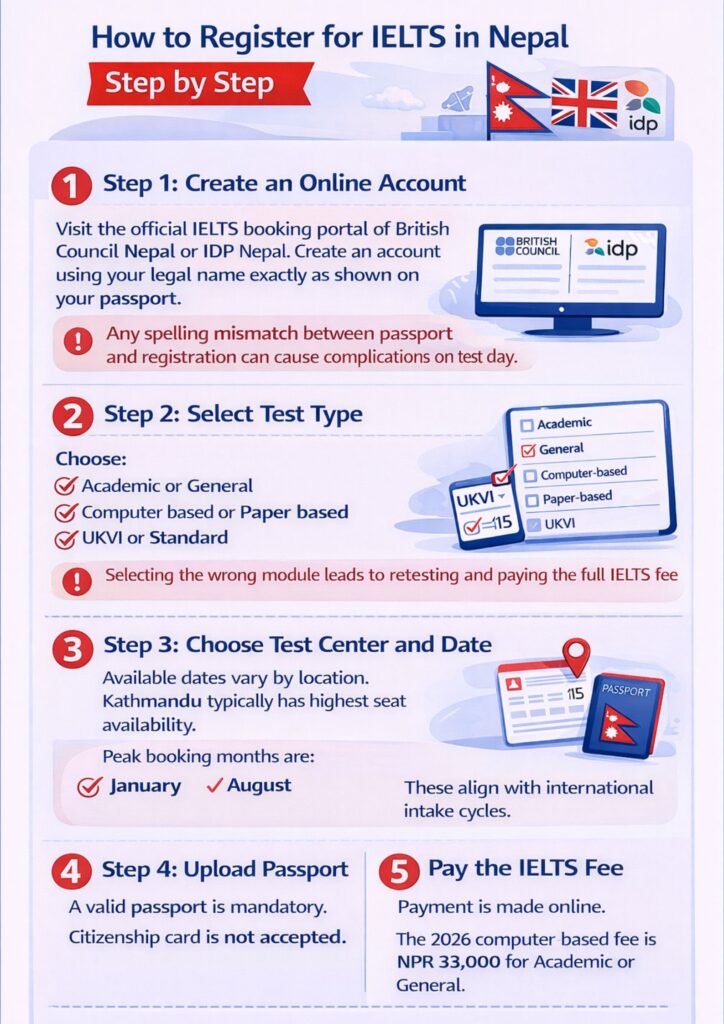
Step 1: Create an Online Account
Visit the official IELTS booking portal of the British Council or IDP Nepal. Create an account using your full legal name as it appears on your passport.
Any spelling mismatch between the passport and registration can cause complications on test day.
Step 2 : Select Test Type
Choose:
Academic or General
Computer based or Paper based
UKVI or Standard
Selecting the wrong module leads to retesting and paying the full IELTS fee again.
Step 3: Choose Test Center and Date
Available dates vary by location. Kathmandu typically has the highest seat availability.
Peak booking months are:
- January
- August
These align with international intake cycles.
Step 4: Upload Passport
A valid passport is mandatory. Citizenship card is not accepted.
The passport must be valid on the test date.
Step 5: Pay the IELTS Fee
Payment is made online. The 2026 computer-based fee is NPR 33,000 for Academic or General.
Booking is confirmed only after successful payment.
Step 6: Receive Confirmation
Confirmation email includes:
- Test venue
- Reporting time
- Candidate number
Students should print the confirmation for safety.
6. IELTS Test Format Explained
Understanding the format reduces anxiety and improves performance.
IELTS is divided into four sections.
Listening
- Duration: 30 minutes
- Four recordings
- 40 questions
Listening includes conversations and monologues. Answers must be written clearly. Spelling errors reduce score.
Reading
- Duration: 60 minutes
- Three passages
- 40 questions
Academic reading passages are analytical and data-heavy. Time management is critical.
General reading passages focus on the workplace and daily communication.
Writing
- Duration: 60 minutes
- Two tasks
In Academic:
- Task 1 requires describing a chart or graph.
- Task 2 requires essay writing.
In General:
- Task 1 requires letter writing.
- Task 2 requires essay writing.
Task 2 carries more weight in scoring.
Speaking
- Duration: 11 to 14 minutes
- Face-to-face interview
Three parts:
- Introduction
- Long turn
- Discussion
Fluency and clarity matter more than accent.
7. IELTS Band Score Explained
IELTS uses a 0 to 9 band scale.
| Band | Skill Level |
|---|---|
| 9 | Expert user |
| 8 | Very good user |
| 7 | Good user |
| 6 | Competent user |
| 5 | Modest user |
Each section receives an individual band. The overall band is the average of all four sections.
Example:
Listening 6.5
Reading 6
Writing 6
Speaking 6.5
Overall band becomes 6.5 after rounding rules.
Canada SDS requires 6.0 in each band.
This means even if the overall score is 6.5, but one section is 5.5, SDS eligibility fails.
This detail is critical.
8. IELTS Score Required for Australia, Canada, UK, and USA
When Nepali students ask, “What IELTS score do I need?”, the honest answer is this: it depends on both the country and the level of the program.
The minimum score printed on a university website is rarely the full story.
Australia
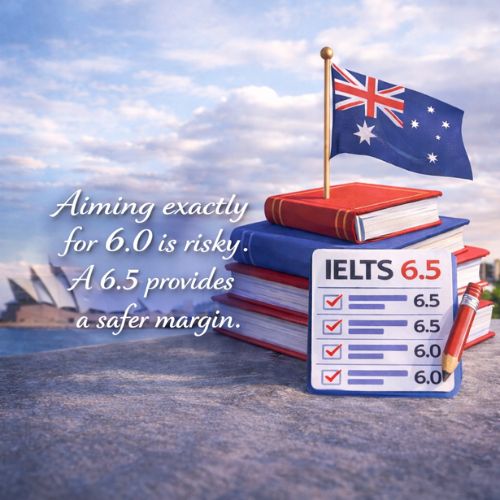
For most undergraduate and postgraduate coursework programs in Australia, the standard minimum requirement is an overall 6.0 band. However, this number represents eligibility, not competitiveness.
Programs such as Nursing, Teaching, Social Work, and other health-related degrees typically require 7.0 overall, sometimes with no band below 7.0. These are regulated professions.
In 2026, English proficiency also influences visa credibility. Under the Genuine Student framework, visa officers may consider whether your English level realistically matches your academic background and chosen course. A weak score combined with a sudden academic shift can trigger scrutiny.
Aiming exactly for 6.0 is risky. A 6.5 provides a safer margin.
Canada
Canada remains highly structured in its English requirement.
For the SDS pathway, which is the faster and more stable route, the requirement is clear: 6.0 in each band. Not overall. Each band.
Even a single 5.5 in Writing disqualifies SDS eligibility.
Non-SDS applications may accept an overall 6.0 with flexibility in bands, but visa scrutiny increases. With rejection rates rising in recent years, students are advised to exceed minimum thresholds rather than meet them.
United Kingdom
Most UK degree programs require 6.0 overall. Competitive universities often require 6.5 or 7.0, depending on the subject.
If applying under UKVI conditions, the IELTS for UKVI Academic version is mandatory. Choosing the wrong test module results in visa refusal, even if the band score is high.
United States
The United States does not set a government minimum score. Requirements are determined by universities.
Most public universities accept 6.5 overall. Private or research-intensive institutions may expect 7.0 or higher.
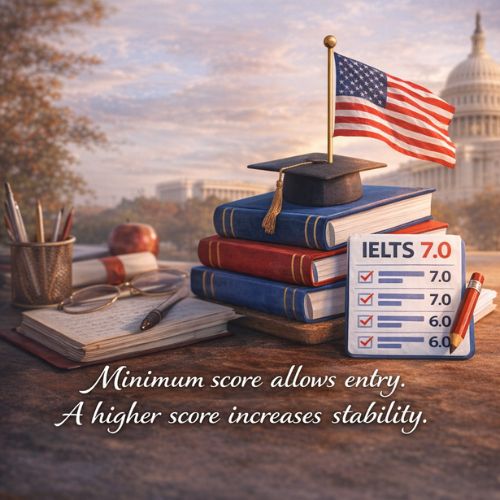
For assistantships and research roles, English fluency expectations are higher, even if the official requirement says 6.5.
The pattern across all four countries is consistent.
Minimum score allows entry. A higher score increases stability.
9. How to Prepare for IELTS in Nepal
Preparation is not about intelligence. It is about structure.
Many Nepali students perform reasonably well in Listening and Reading because these sections reward repetition and exposure. The real challenge is writing.
Writing requires organization, argument clarity, grammar accuracy, and task response discipline.
Ignoring Writing is the most expensive mistake.
Self-Study Strategy
Self-study works for disciplined candidates.
The most reliable materials remain Cambridge IELTS books 10 to 18. These contain real past exam formats and an authentic difficulty level.
A strong routine includes:
- Listening practice daily with timed conditions
- Reading practice under strict 60 minute limits
- Writing Task 2 essay every two days
- Speaking practice recorded and reviewed
Speaking improves when students analyze fluency, hesitation, and pronunciation objectively.
Self-study is effective if feedback is available, especially for writing.
30-Day, 60-Day, 90 Day Preparation Timeline
A 30-day plan requires 2 to 3 hours daily with intense focus. This suits candidates already scoring 6.0 in mock tests.
A 60-day plan allows balanced preparation, correction cycles, and gradual improvement.
A 90-day plan is safer for students currently below 5.5. It allows grammar strengthening and vocabulary expansion without burnout.
Consistency matters more than occasional long study sessions.
10. IELTS Coaching Cost in Nepal 2026
IELTS Coaching in Nepal typically costs between NPR 7,000 and NPR 15,000 for a standard 6-week course. Premium packages, unlimited classes, or small group batches may reach NPR 30,000.
Most courses run for approximately 6 weeks.
Mock tests are often charged separately at NPR 400 to 500 per test. Some centers offer bundled packages.
Coaching offers a structured environment and writing correction. That is the primary value.
However, no institute can guarantee a 7-band. Improvement depends on student engagement and practice outside class.
Choosing coaching is about accountability, not shortcuts.
11. Computer Based vs Paper Based IELTS
The difficulty level of both formats is identical.
The difference lies in experience and comfort.
| Factor | Computer Based | Paper Based |
|---|---|---|
| Fee | NPR 33,000 | NPR 36,200 |
| Result Time | 3 to 5 days | 13 days |
| Writing | Typing | Handwriting |
| Availability | More flexible dates | Limited dates |
Students who are comfortable with typing generally prefer computer-based. Faster result release also benefits those working with tight admission deadlines.
Students with slower typing speed or discomfort with screens may prefer paper-based.
There is no scoring advantage in either format.
12. Common Mistakes Nepali Students Make in IELTS
The most damaging mistake is memorizing essays from the internet.
Examiners are trained to detect memorized structures and unnatural phrasing. When detected, scores drop sharply under Task Response and Coherence.
Other frequent errors include:
- Poor time allocation in Reading
- Spending too long on Writing Task 1
- Ignoring word limit
- Overconfidence in Listening
- Speaking in a rehearsed, unnatural tone
Retaking IELTS multiplies the total cost. One failed attempt often leads to paying NPR 33,000 again.
Preparation discipline reduces financial risk.
13. IELTS Score Validity and Rechecking Process
The IELTS score remains valid for 2 years from the test date.
After 2 years, retesting is mandatory for both admission and visa.
If a student believes their score does not reflect performance, they may apply for Enquiry on Results within 6 weeks of result publication.
If the band score increases, the rechecking fee is refunded. If unchanged, the fee is retained.
Rechecking is most effective when the writing score is significantly lower than the other bands.
Otherwise, retaking may be more practical.
14. IELTS Strategy for Study Abroad from Nepal
IELTS timing must align with application deadlines.
Taking the test too early risks score expiration before visa processing. Taking too many risks, missing intake deadlines.
A safe approach is to take IELTS 3 to 6 months before application submission.
Target score should exceed the minimum requirement. A 6.5 offers stronger safety than a 6.0.
Planning reduces stress and prevents rushed attempts.
15. Is IELTS Enough for Visa Approval
This is one of the most misunderstood areas.
IELTS is necessary. It is not sufficient.
Visa officers evaluate:
- Financial capacity
- Academic progression
- Course relevance
- Study plan clarity
- Genuine intent
A student with 7.0 IELTS but a weak bank statement faces a high risk.
A student with a 6.5 IELTS score and strong documentation has greater stability.
IELTS opens the first door. Documentation determines final approval.
Frequently Asked Questions About IELTS in Nepal 2026
1. How much is the IELTS exam fee in Nepal in 2026?
As of February 2026, the official IELTS exam fee in Nepal is:
- NPR 33,000 for Computer-based Academic or General
- NPR 36,200 for Paper-based Academic or General
- NPR 36,400 for Computer-based UKVI
- NPR 39,600 for Paper-based UKVI
Computer-based IELTS is NPR 3,200 cheaper than paper-based for standard modules.
Fees are the same for both British Council IELTS Nepal and IDP IELTS Nepal.
2. How to register for IELTS in Nepal?
To register for IELTS in Nepal:
- Create an account on British Council or IDP website
- Choose Academic or General
- Select computer or paper format
- Choose test date and center
- Upload passport copy
- Pay the fee online
- Receive confirmation email
A valid passport is mandatory. Citizenship card is not accepted.
3. How many times can I take IELTS in Nepal?
There is no limit to how many times you can take IELTS.
However, you must pay the full fee every time.
If your score is close to your target, consider Enquiry on Results before retaking.
4. What IELTS score is required for Canada from Nepal?
For Canada SDS pathway, the requirement is:
- Minimum 6.0 in each band
For non SDS, overall 6.0 to 6.5 is usually acceptable depending on program.
Each band matters. A single 5.5 can disqualify SDS eligibility.
5. What IELTS score is required for Australia from Nepal?
Most Australian universities require:
- Overall 6.0 for undergraduate and postgraduate programs
Nursing, teaching, and health programs often require 7.0.
Visa officers also evaluate English during Genuine Student assessment.
6. What IELTS score is required for UK from Nepal?
UK degree programs typically require:
- 6.0 overall
Top universities may require 6.5 or 7.0.
If applying under UKVI route, you must take IELTS for UKVI.
7. Is IELTS difficult for Nepali students?
IELTS is not difficult, but it is structured.
Most Nepali students struggle with:
- Writing Task 2 structure
- Time management in reading
- Overconfidence in listening
Consistent practice for 6 to 8 weeks significantly improves score.
8. Can I take IELTS without coaching in Nepal?
Yes.
Many students prepare using:
- Cambridge IELTS books
- Online practice tests
- Daily writing practice
Coaching is helpful for writing and speaking feedback but not mandatory.
Self study works if discipline is strong.
9. How long is IELTS valid?
IELTS score is valid for 2 years from the test date.
After 2 years, you must retake the test.
Expired scores are not accepted for university admission or visa.
10. Is computer-based IELTS easier than paper-based?
No.
The difficulty level is exactly the same.
The only differences are:
- Typing instead of handwriting
- Faster result release
- Slightly lower fee
Your score depends on performance, not format.
11. What documents are required for IELTS registration in Nepal?
You need:
- Valid passport
- Online payment method
- Active email address
No academic documents are required for IELTS booking.
12. How long does it take to get IELTS results?
- Computer-based IELTS results are usually available within 3 to 5 days
- Paper-based IELTS results are released in 13 days
Official Test Report Form can be downloaded online.
13. What is a good IELTS score for Nepali students?
A safe score for study abroad is:
- 6.5 overall with no band less than 6.0
This keeps more country options open.
7.0 or higher improves scholarship and competitive university chances.
14. Is IELTS enough for visa approval?
No.
IELTS is required but not sufficient.
Visa approval depends on:
- Financial proof
- Academic progression
- Clear study plan
- Genuine student assessment
Many visa refusals occur despite strong IELTS scores.
15. Which is better British Council or IDP in Nepal?
Both are official IELTS test providers.
The test format, scoring, and difficulty are identical.
Choose based on:
- Available test dates
- Location convenience
- Format availability
There is no scoring advantage with either provider.

Bishad Kandel has been writing for the past three years across different niches, combining creativity with research-driven insights. With a degree in Information Technology, he brings a strong background in data analysis to his work, ensuring every blog he writes is factual, engaging, and meaningful. His approach blends storytelling with evidence, making complex topics easier to understand for readers.