Did you know that in 2026, the difference between approval and refusal is often not your GPA? It is your documentation.
Over the last three years, more and more Nepali students have been facing visa rejections. In some courses and countries where checks are stricter, nearly 7 out of every 10 students have been refused.
This means that in certain high-risk areas, rejection rates have gone as high as 74 per cent, which is the highest seen in recent years. And this is because many Nepali students doesn’t really prepare well before applying abroad for studies.
In fact, if you look closely at the Industry data, you will see that nearly half of these refusals are linked directly to documentation issues, weak financial proof, or unclear Genuine Student narratives. In Australia’s VET sector alone, approval rates dropped below 11 per cent in late 2025 after tighter integrity screening.
What does this mean for you?
It means immigration systems are no longer looking for potential alone. They are looking for alignment. Bank statements must match income logic. Academic history must match course selection. Every signature, every date, and every name spelling must be consistent.
A visa officer does not reject emotion. They reject a mismatch.
And in today’s environment, even a small inconsistency can shift your file from credible to questionable. Documentation is not a formality anymore. It is the foundation.
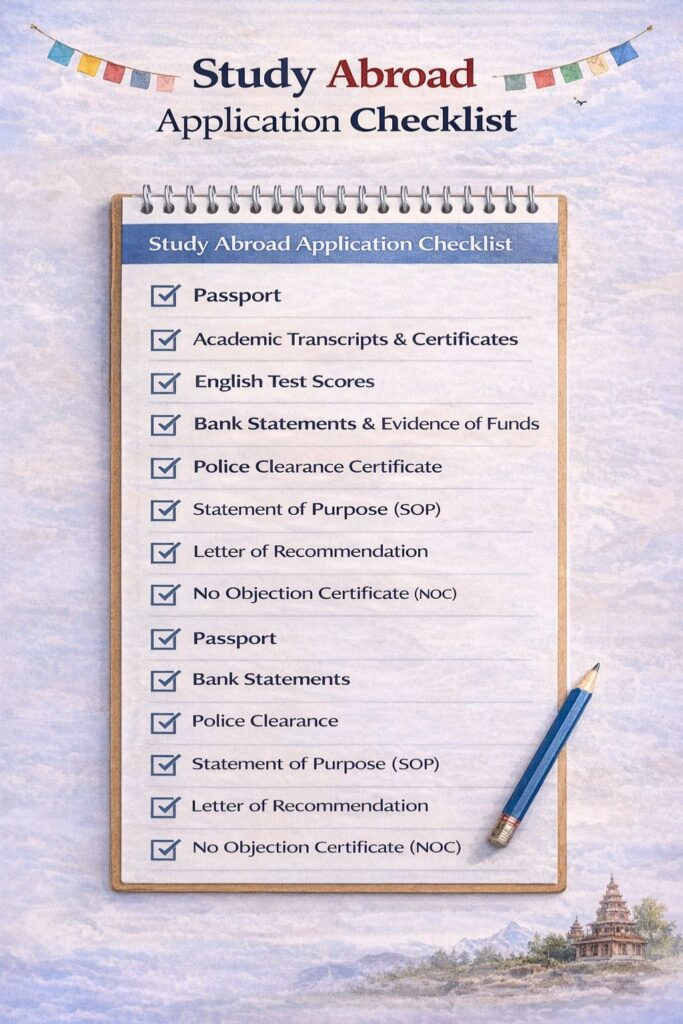
Initial Checklist For Documents Required for Nepali To Study Abroad
Before we go deeper into individual documents, you need to understand one thing clearly.
Immigration systems do not review papers randomly. They review them in layers.
Each layer answers a different question. And in 2026, after increased scrutiny on Nepali applicants, these layers are examined more carefully than ever. This is why we prepare how to study abroad from Nepal, which will help you step by step to apply in foreign country.
The first layer is your academic history. Universities and visa officers want to see progression. This includes consolidated transcripts, provisional or degree certificates, and official attestation when required. In Nepal, consolidated transcripts are now mandatory for visa stages, and issuance can take 15 to 30 days. Formatting inconsistencies from TU, PU, or KU are accepted internationally, but only if properly verified.
Academic History Documents Checklist
• Consolidated transcripts from your university or board
• Individual semester or yearly mark sheets (if required)
• Provisional certificate or degree certificate
• Character certificate from your institution
• Migration certificate (in some cases)
• Official attestation or verification when required
• Backlog or re-examination records (if any)
• Medium of instruction letter (if needed)
• Transcript request or verification receipt
Once progression is established, the next layer confirms identity.
| Identity Requirement | 2026 Standard |
|---|---|
| Passport Validity | Minimum 6 months |
| Blank Pages | At least 2 |
| Passport Type | Biometric passport standard |
| PCC Validity | Usually 6 months |
After identity comes academic readiness.
| English Proof | 2026 Position |
|---|---|
| Validity | 2 years |
| Digital Score Report | Fully accepted |
| One Skill Retake | Accepted selectively |
Then comes financial credibility.
Funds must show a logical history. Many systems now review three-month or longer holding periods. Bank certificates must be recent, often within 14 to 30 days. A six-month transaction history is commonly examined to detect sudden deposits.
Finally, application documents explain intent.
Statement of Purpose, recommendation letters, CV, and compliance documents, such as the NOC, form the narrative layer. They connect your academic and financial information into a coherent story.
Financial Documents Checklist
• Bank balance certificate issued recently (usually within 14 to 30 days)
• Bank statements showing at least six months of transaction history
• Evidence of regular income such as salary, business, or rental income
• Tax clearance or income tax return documents
• Sponsor relationship proof (parents, guardians, or relatives)
• Affidavit of support or sponsorship letter
• Fixed deposit certificates or investment proof (if applicable)
• Loan sanction letter and repayment plan (if using education loans)
• Source of funds explanation for large or recent deposits
Each category supports the next. If progression is weak, financial strength cannot compensate. If identity records mismatch, academic excellence loses weight.
In 2026, documentation works like architecture. Remove one structural pillar, and the rest begins to fall.
So, now let’s discuss each of those documents in full detail.
1. Academic Documents Required For Nepali Students
Your academic documents will not just show what you studied. They show whether your journey makes sense.
Under increased scrutiny for Nepali applicants, especially after Australia’s Assessment Level 3 classification, embassies now review your education from the very beginning. For Master applicants, SLC/SEE documents are increasingly requested by Australia and the USA to verify a continuous timeline. Even when not mandatory for other countries, omitting SEE documents often triggers a Request for Information, which delays processing.
But in case you lost those certificates, duplicate SEE certificates currently take 5 to 7 working days at Sanothimi, but only after filing a police report. Universities abroad also struggle with Nepal’s GPA system. An official grading scale letter from NEB is often necessary to prevent a 2.8 GPA from being interpreted below 60 per cent.
But in case you want to know what might be your gpa as per the international standards, here is the simple converter that we made, which you can use for free:
Nepali Grade Converter for Study Abroad
The same continuity logic continues at the 10+2 level. NEB transcripts are consolidated, but subject attempt years reveal backlogs indirectly. Migration certificates are mandatory for university admission and NOC processing, though rarely requested by embassies.
At Bachelor level, consolidated transcripts are mandatory for visa review. However, if you have backlogs, submitting semester-wise marksheets strengthens credibility by showing eventual clearance. TU provisional certificates now take 2 to 4 weeks, while PU and KU issue within 7 to 10 days. Visa offices still require high-resolution scans of physical originals with wet-ink stamps.
Backlogs and gaps are where risk intensifies.
| Risk Factor | 2026 High Risk Threshold |
|---|---|
| Backlogs | More than 8 |
| Gap Requiring Strong Proof | More than 2 years |
| High Refusal Trigger | More than 5 years gap |
Gaps beyond two years require salary slips, tax returns, or formal employment letters. Beyond five years, applications face significant non-genuine risk without strong documentation.
Finally, translation and notarization must be precise. Self-attestation is rejected. A certified translator seal is mandatory for Nepali-to-English conversion. Notary costs range from NPR 500 to 1,000, while translation with notarization ranges from NPR 1,500 to 3,000.
MOFA attestation is increasingly requested for Level 3 scrutiny and mandatory for scholarships, though not universally required for all destinations.
2. Identity Documents Should Be the Same
Before an embassy evaluates your academics or finances, it asks a much simpler question first. Are you the same person on all the documents you have submitted?
That is why identity documents are reviewed before anything else. In the case of Nepal, even small inconsistencies are no longer treated as harmless clerical errors. They are treated as possible credibility gaps. And credibility, once shaken, is difficult to rebuild inside a visa file.
It usually begins with your passport. Legally, most destinations require only 6 months of validity from your travel date. However, in practice, we recommend keeping validity for the full duration of your course. Renewing a passport while studying abroad is possible, but it complicates visa stamping, residence permits, and bank formalities.
From the passport, attention immediately shifts to your name.
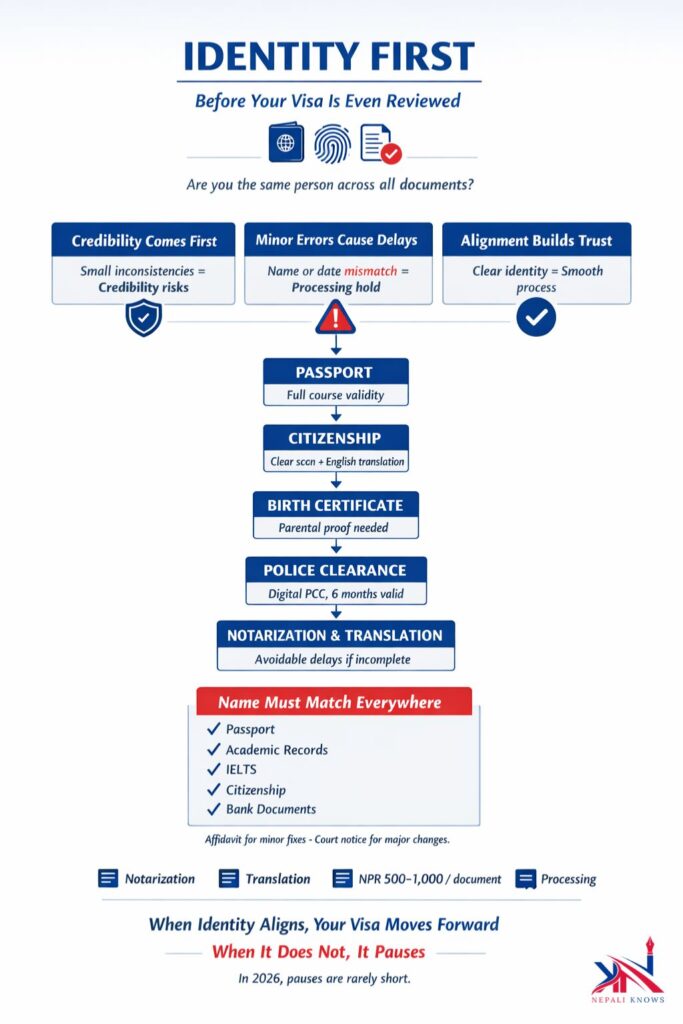
In Nepal, spelling variations are common. A surname shortened in SEE, written differently in citizenship, or registered slightly differently during IELTS booking can trigger administrative processing. A minor spelling difference can usually be corrected through a notarised “One and the Same Person affidavit”. But a major name change requires a court-verified notice. What feels small locally can become significant internationally.
This is why citizenship documents matter just as much. A clear front and back colour scan is required. If the original is in Nepali, a certified English translation with a translator’s seal is mandatory. Self-attestation is not accepted at the visa stage.
The same logic extends to birth certificates. While many students assume they are required only for minors, they are increasingly requested to verify parental sponsorship links. When financial documents depend on family support, identity relationships must be provable.
After identity comes background verification.
Police Clearance Certificates are now processed within 2 to 5 working days through Nepal’s OPCR system. Digital PCC with QR code is widely accepted, although some cases still request stamped physical copies. Validity generally remains 6 months for visa purposes, so timing matters.
Finally, every supporting document must be properly notarised or, where required, translated. In Kathmandu, notarization averages NPR 100 to 300 per page, while certified translations cost around NPR 500 to 1,000 per document. These may seem like small administrative steps, but incomplete notarization is one of the most common avoidable delays.
Identity documents do not operate separately. Your passport, citizenship, birth certificate, and police clearance must align in spelling, dates, and parental details. When they do, your file moves forward quietly. When they do not, it pauses. And in 2026, pauses are rarely short.
3. English Proficiency Documents For Nepali Students
Your English test score is not just a number; it is a digitally verified credential that embassies cross-check directly with the testing authority.
This means uploading a scanned PDF is no longer enough. Visa officers now verify scores through official portals operated by IDP, British Council, Pearson, and ETS. If your score cannot be digitally matched, your application is treated as incomplete.
Validity is the first silent risk.
All major student visas strictly enforce the 2-year validity rule. What many students do not realise is that the score must be valid at the time of visa submission. If your result expires during reapplication after a refusal, it cannot be reused. Even more dangerous is filing a visa with less than 30 days of validity remaining. A small processing delay can automatically invalidate your file.
The second common mistake is module confusion.
IELTS Academic is mandatory for university-level student visas. Submitting General Training for a Bachelor’s or Master’s application is a direct refusal ground. It signals that your intent may not align with the study.
Documentation format also matters. Physical TRFs are still issued in Nepal, but embassies now rely on digital verification systems. For PTE, you must release your score through your Pearson account. For TOEFL, institutional codes must be used to send official reports. Screenshots are categorically rejected.
One Skill Retake(OSR) has added complexity.
| Country | OSR Acceptance at Visa Stage |
|---|---|
| Australia | Accepted |
| UK | Accepted |
| Canada | Largely not accepted |
| USA | Varies by institution |
Although legally accepted in some systems, OSR results can still invite deeper scrutiny. A clean single-sitting result is often viewed as stronger evidence of academic readiness.
Finally, low single bands and score course mismatch remain the leading refusal triggers. An overall 6.5 with a 5.0 in one section can undermine credibility. Applying for a course requiring 7.0 with a 6.0 will be refused, regardless of admission.
In 2026, English proficiency is not about passing the test. It is about submitting a score that is valid, digitally verifiable, academically aligned, and structurally consistent with your course level.
4. Financial Documents Required For Nepali Students
If academic documents prove your past, financial documents prove your intent.
And in recent times, embassies no longer focus only on how much money you show. They focus on where that money came from. The source of funds has become more important than the bank balance itself.
This shift begins with holding period rules.
Some systems still enforce a strict 28-day consecutive holding requirement, where funds must remain untouched, and the statement must be issued within 31 days of visa submission. In other cases, a 3-month holding history has become the practical gold standard. If the funds are newer than that, a clear source of funds explanation supported by tax paid evidence becomes mandatory.
Sudden large deposits remain the number one refusal trigger. Officers now review transaction velocity. If an account jumps from NPR 5 lakhs to NPR 50 lakhs in a week without a documented land sale, loan sanction, or business withdrawal trail, it is treated as layering.
The depth of statements also matters.
| Requirement | 2026 Standard |
|---|---|
| Statement History | 4 to 6 months |
| Certificate Validity | 14 to 30 days old maximum |
| Digital Acceptance | Only if QR verifiable |
If your digital statement cannot be verified through a bank system, a wet-ink stamp and a manager’s signature are required.
Besides that, the sponsorship structure must also make sense. If parents sponsor you, a citizenship copy, a relationship certificate, an income certificate covering at least 3 years, and a tax clearance are expected. If a relative sponsors you, an affidavit of support and proof of disposable income are necessary. If the sponsor is a business owner, PAN or VAT registration, an audit report, and company registration documents are reviewed.
Apart from that, income must match deposits as well. If someone claims an NPR 20 lakhs annual income but shows no salary credits or business inflow pattern, credibility collapses automatically.
Talking about the Education loans, they are currently the strongest financial evidence. A sanction letter from a Grade A commercial bank signals that the bank has already performed due diligence. However, some systems may later request proof of disbursement or margin payment before travel.
With fast-track streams discontinued in certain destinations, lump-sum instruments such as GIC alone are no longer sufficient. Officers now demand a 4 to 6-month history proving the origin of that amount. Property valuation may strengthen home ties, but it does not count as liquid funds.
But in Nepal, fraudulent documents are quite common, but you need to remember that Financial fraud carries severe consequences. QR verification and direct bank inquiries are common. Discovery of fake documents can result in long-term bans.
In 2026, money must be liquid, traceable, tax paid, and logically accumulated. Because once financial credibility is questioned, the rest of the file is reviewed under suspicion.
5. Required University Application Documents
If financial documents prove capacity, application documents prove intention.
This is where your story is examined. Not emotionally, but logically. In 2026, universities and visa officers are no longer reading essays casually. They are testing consistency, alignment, and authenticity.
It begins with the Statement of Purpose.
An SOP is mandatory for all major destinations. For some systems, it directly influences admission. For others, it becomes the foundation of your visa credibility. In certain cases, long essays have been replaced by structured questions that must be answered precisely. Instead of storytelling, applicants must now respond to targeted prompts that evaluate academic progression and future plans.
General SOP length remains around 800 to 1,000 words. But the risk is no longer about length. It is about originality.
Universities now use AI detection systems and plagiarism indicators. Submitting a copied or heavily AI-generated SOP can result in immediate refusal and, in serious cases, long-term bans under integrity provisions. A mismatch between your English test score and overly advanced SOP language also raises suspicion.
The same logic applies to Letters of Recommendation.
| Level | Typical Requirement |
|---|---|
| Bachelor | 1 to 2 LORs |
| Master | 2 to 3 LORs |
Fresh graduates must provide academic referees. Applicants with more than two years of experience are often expected to include at least one professional LOR. Most institutions prefer digital submissions sent directly by the referee through official links. For paper based systems, letters must be on institutional letterhead with a wet ink signature. Generic Gmail addresses for referees are increasingly verified and often rejected.
After that comes the CV.
A CV is mandatory at the university stage and strongly recommended for visa review. It must provide a continuous timeline. In 2026, even gaps longer than three months should be explained clearly within the CV itself. Whether it was exam preparation, internship, or employment, unexplained silence is interpreted as uncertainty.
Formatting expectations vary. North American systems prefer one-page, achievement-focused resumes. European systems often require structured reverse chronological formats.
For creative programs, documentation becomes visual.
Architecture, design, and fine arts programs require digital portfolios. Most submissions are capped between 6 and 10 MB or 10 and 20 pages. Increasingly, elite institutions conduct live portfolio reviews to confirm originality and prevent AI-generated submissions.
The most common application failures in 2026 are no longer technical mistakes. They are narrative failures.
| Error | Consequence |
|---|---|
| Copy paste SOP | Immediate rejection |
| Inconsistent career story | Genuine intent refusal |
| English mismatch | Ghostwriting suspicion |
| Fake LOR | Verification failure |
Application documents must align with academic records, financial capacity, and English scores. When your SOP says Nursing, your CV should show healthcare exposure. When your IELTS shows 6.0, your writing tone should realistically reflect that level.
Because in 2026, universities and embassies are not just asking what you want to study.
They are asking whether your documents tell the same story.
6. Nepal Specific Mandatory Document
After admission and before tuition transfer, there is one document that exists only because you are a Nepali citizen. The NOC.
In 2026, the NOC is not optional. It is legally mandatory for any student transferring tuition or foreign currency through Nepalese banks. Without a verified NOC, banks will refuse to process payment.
The application process is now fully digital through the MoEST NOC portal. Approval typically takes 1 to 3 working days. Physical visits to Sanothimi are no longer required unless your application is flagged for a mismatch or the institution is not recognised.
The standard requirement remains:
- Offer letter from a recognised institution
- Passport and citizenship scan
- Latest academic transcript
- NPR 2,000 fee paid via ConnectIPS or eSewa
In 2026, the most common delay is not missing documents. There is a name inconsistency between the passport and the academic records. Even a minor spelling variation can push the application into manual review.
The NOC is not just a clearance. It is your financial gateway.
7. Medical Examination Documents Required For Nepali Students
Once financial credibility is established, the next checkpoint is health clearance.
Medical examinations must be conducted through approved panel physicians. In Nepal, the International Organisation for Migration remains the central authority, with approved centres including Norvic International Hospital and Travel and Mountain Medical Centre.
Appointments during peak intakes often require 7 to 14 days’ advance booking. Planning late can delay visa submission.
Validity varies:
| Medical Type | Validity Period |
|---|---|
| TB Test | 6 months |
| Full Medical | 12 months |
Costs in 2026 range between NPR 7,100 and NPR 10,800, depending on required tests.
Medical reports are electronically uploaded to immigration systems. You do not receive a traditional report to submit manually. This is another example of digital-first verification replacing paper handling.
Timing matters. Submitting medical too early can cause expiry before travel. Submitting too late can delay processing.
How to Properly Organise Your Documents Before Submission
In 2026, document rejection often begins with poor formatting.
Embassies now use AI-powered Optical Character Recognition systems. If your scan is unclear, blurred, or black and white, it may be marked unverifiable.
Minimum standards are strict:
| Standard | Requirement |
|---|---|
| Resolution | 300 DPI minimum, 600 DPI preferred for IDs |
| Color | Full color mandatory |
| Format | PDF only for documents |
| File Size | 4MB to 5MB per file limit |
| Naming | GivenName_Surname_DocumentName.pdf |
Low-quality scans are no longer minor mistakes. They trigger document resubmission requests, which extend processing time.
Files should be organised digitally in clearly labelled folders. Physical originals should be separated from notarised copies in transparent sleeves. Never staple originals. Never mix translations with originals in the same scan without clear labelling.
Organization reflects seriousness. And seriousness affects perception.
Common Documentation Mistakes Nepali Students Make
Most refusals in 2026 are not because students are unqualified. They are because documentation fails integrity checks.
Over 40 per cent of refusals are linked to financial inconsistencies such as layering or sudden deposits without tax paid proof.
Fraud consequences are severe. Under Public Interest Criterion 4020, submitting false information can result in a 3 to 10-year ban. In some cases, passport cancellation and domestic legal penalties have been reported.
Common patterns include:
| Mistake | Risk Level |
|---|---|
| Sudden large deposit | High |
| Fake bank statement | Extreme |
| Name mismatch | Moderate to High |
| Expired English score | Automatic refusal |
| Unnotarized translation | Immediate resubmission |
The most dangerous mistake is assuming that small inconsistencies will be overlooked. In 2026, verification is automated. Banks are cross-checked. Universities are contacted. Referees are called.
Shortcuts are no longer hidden.
Important Note About Country-Specific Variations
While this guide remains country-neutral, variations still exist.
Some systems enforce strict 28-day holding periods. Others expect 3 month transaction history. Some rely heavily on digital score sharing. Others emphasize interview performance.
Financial thresholds differ. Maintenance requirements change yearly. Medical validity periods vary.
For this reason, always cross-verify with the official embassy checklist before filing.
Because in 2026, documentation is no longer about collecting papers.
It is about proving that every claim you make can survive verification.
FAQs
What documents are required to study abroad from Nepal in 2026?
Students need academic transcripts, certificates, English test scores, financial proof, passport, police clearance, SOP, recommendation letters, and NOC. In 2026, embassies focus on document consistency and financial source verification more than just eligibility.
Why are Nepali students facing more visa rejections?
Visa refusals are increasing due to strict Genuine Student and integrity checks. Many rejections are linked to financial inconsistencies, weak SOPs, sudden bank deposits, or mismatched academic progression rather than GPA alone.
How important are financial documents for student visa?
Financial documents are now the most important factor. Visa officers check fund source, tax records, holding period, and transaction history. Sudden deposits without proof are a major refusal reason.
How much bank balance is required for study abroad?
The required balance depends on the country. However, most Nepali students need funds covering tuition and living costs for one year. More importantly, money must be traceable, stable, and logically accumulated.
What is the biggest documentation mistake Nepali students make?
The most common mistake is showing large funds without a clear source. Fake bank statements, expired IELTS, name mismatches, and incomplete notarization also lead to refusals.
Do embassies verify bank statements in 2026?
Yes. Many systems now verify statements through QR codes, bank contacts, and digital systems. Fraudulent financial documents can lead to visa bans for several years.
Is SOP important for visa approval?
Yes. SOP is now treated as a credibility document. It must logically connect academic history, career goals, and course selection. Generic or copied SOPs increase refusal risk.
How long should bank funds be maintained?
Many countries expect 3 to 6 months of financial history. Some systems still require 28 days consecutive holding. A longer and stable history improves credibility.
What is Public Interest Criterion 4020?
PIC 4020 is an integrity rule used in some countries. Submitting false or misleading documents under this rule can result in long-term bans and future visa refusals.
Can education loans improve visa chances?
Yes. Loans from recognized banks are considered strong financial proof because banks perform due diligence before approval.
Do embassies check academic gaps?
Yes. Study gaps must be explained with work experience, internships, or professional development. Long unexplained gaps increase refusal risk.
Are SEE and school certificates required for a Master’s?
Increasingly, yes. Some countries request school records to verify academic continuity. Missing early documents can delay processing.
Is notarization mandatory for student visa documents?
Yes. Certified translations and notarized copies are required when documents are in Nepali. Self-attestation is not accepted at visa stage.
How important is consistency in documents?
Consistency is critical. Names, dates, and academic timelines must match across passport, transcripts, and financial records. Even small mismatches can delay or reject applications.
Do visa officers check digital IELTS scores?
Yes. Embassies verify scores directly through official portals. Screenshots or unofficial copies are rejected.
What happens if my IELTS expires during visa processing?
If your English score expires before submission or decision, your application may become invalid. Always ensure sufficient validity.
Can relatives sponsor Nepali students?
Yes. But relationship proof, income documents, and legal sponsorship letters are required. Sponsors must show stable income and logical financial strength.
How do embassies detect fake documents?
Modern systems use digital verification, bank inquiries, referee checks, and AI-based fraud detection. Discovery of fake documents can lead to bans.
How should I organize documents for visa submission?
Documents must be scanned in high resolution, labelled clearly, and submitted in structured folders. Poor formatting delays processing.
Why is documentation more important than GPA in 2026?
Immigration systems now focus on credibility and genuine intent. Strong documentation proves that your academic plan, finances, and future goals are realistic and consistent.

Bishad Kandel has been writing for the past three years across different niches, combining creativity with research-driven insights. With a degree in Information Technology, he brings a strong background in data analysis to his work, ensuring every blog he writes is factual, engaging, and meaningful. His approach blends storytelling with evidence, making complex topics easier to understand for readers.