Buying a bike or scooter in Nepal is not just about checking the bike price or asking for the scooter price.
But the reality is that many Nepalis still walk into a showroom, ask about EMI bike options, and decide within an hour.
However, later, they realize the servicing cost is higher than expected. Spare parts are expensive. Mileage is lower in traffic. Resale value is not strong.
This happens because the real cost of owning a vehicle in Nepal is not the showroom price. It is the 5-year ownership cost.
If you are searching for how to buy a bike in Nepal or how to buy a scooter in Nepal, this guide will help you think long-term.
First, before talking about price or a loan, you must decide on one important thing.
Do you actually need a bike or a scooter?
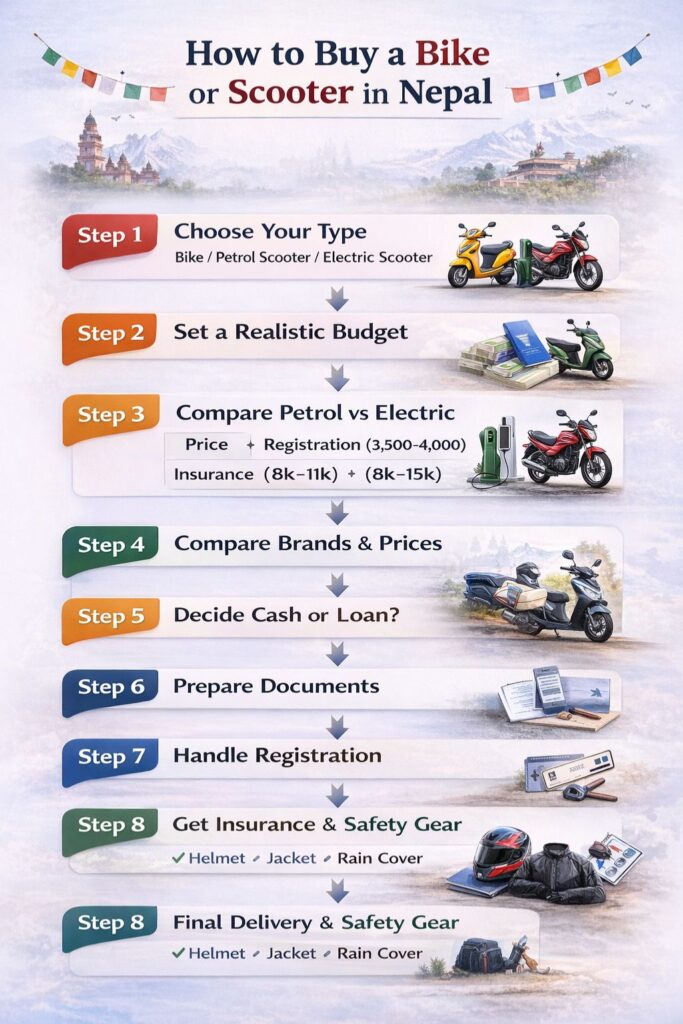
Step 1 – Decide Whether You Need a Bike, a Petrol Scooter, or an Electric Scooter
Before checking the bike price in Nepal or asking about the EMI bike Nepal, pause for a moment.
Most people think buying a vehicle is about choosing a brand. In reality, it is about choosing the right category for your daily life.
If you choose the wrong type, even a low-interest loan or good mileage will not save you from long-term frustration.
So the first step in how to buy a bike in Nepal or how to buy a scooter in Nepal is this:
Understand your daily use honestly.
What do most Nepali people think?
Many buyers assume a bike is always stronger and better. Some think scooters are only for short distances and students.
Others believe an electric scooter automatically means huge savings. These thoughts come from friends, social media, or showroom talk.
But Nepali roads do not follow marketing logic.
They follow traffic, potholes, uphill climbs, and daily workload.
The Reality Of Bike Or Scooters In Nepal
Let us look at real conditions instead of assumptions.
If you travel 10 to 15 km daily in Kathmandu traffic, you spend most of your time stopping and starting. In that situation, comfort matters more than top speed.
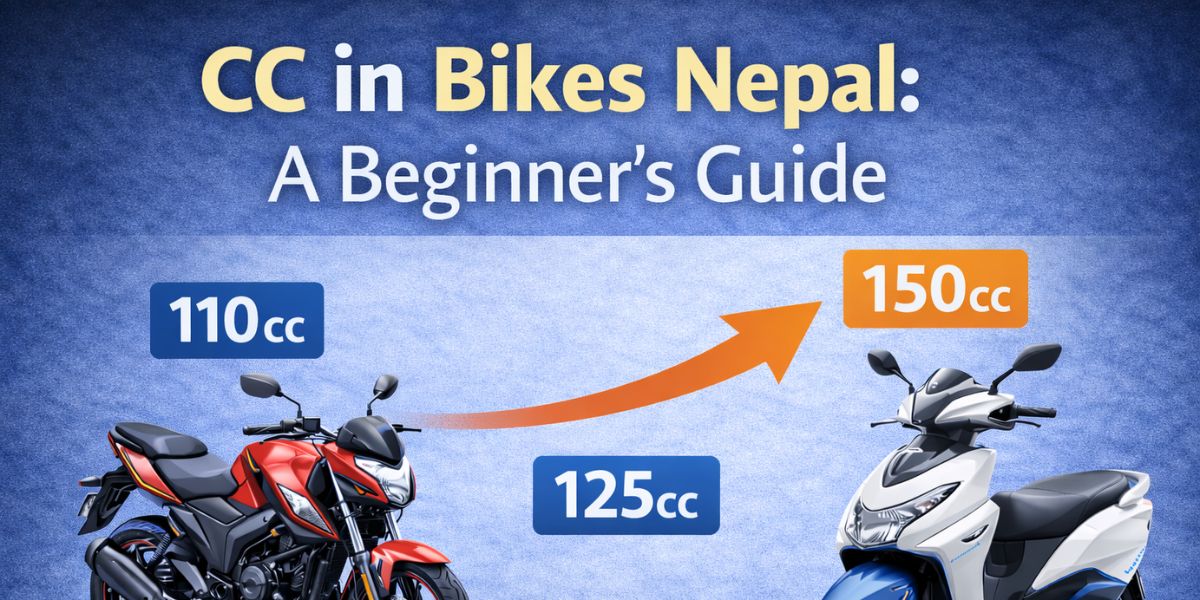
A 110cc scooter giving 45 to 55 kmpl is usually enough. You do not use the full engine capacity anyway. Automatic transmission makes traffic easier. Less clutch work means less fatigue.
Now compare that with someone traveling 25 to 40 km daily, mixing the ring road, highway, and uphill sections. In this case, a 125cc bike giving 55 to 62 kmpl becomes more practical. It offers better stability on uneven roads and handles loads better. A bigger CC might not always be practical in the context of Nepal.
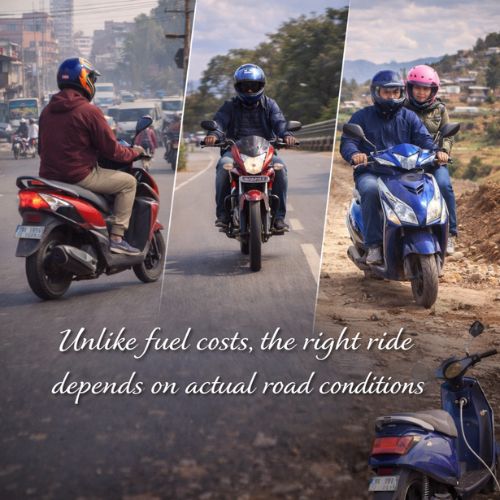
Then there is rural riding. Broken roads. Steep climbs. Two passengers. Sometimes load. In this situation, wheel size and suspension matter more than convenience. A bike handles potholes better over time.
An electric scooter changes the cost equation but not the road conditions. It can reduce petrol cost from roughly NPR 3 to 3.5 per km down to below NPR 0.40 per km for electricity. That is a big difference.
But electric does not remove battery cost. After 3 to 5 years, replacement can cost between NPR 50,000 and NPR 140,000. Many buyers ignore this future maintenance.
Running Cost vs Real Ownership Cost
Fuel cost is visible every week. Battery replacement or resale loss is invisible until later.
This is where many people make mistakes.
If you ride 15 km daily in city traffic and have reliable home charging, an electric scooter can reduce daily running costs significantly.
But if you live outside major cities where EV workshop support is limited, even small technical issues can become a headache.
Petrol bikes and scooters have strong spare parts availability across Nepal. Almost every town has a mechanic who understands Honda, Yamaha, Bajaj, or TVS engines.
That reliability reduces stress.
Resale Value Of Bikes In Nepal
In Nepal, resale value directly affects your real cost of ownership.
Honda bikes and scooters hold value strongly in second hand market. Yamaha also performs well.
Electric resale depends heavily on battery health. Buyers worry about replacement cost. That uncertainty reduces resale confidence.
If you plan to upgrade after 3 years, this factor becomes important.
What You Should Consider Instead
Instead of asking which model looks better, ask these practical questions:
- How many km do I travel daily in traffic?
- Are my roads mostly smooth or full of potholes?
- Do I have easy and reliable charging access at home?
- Will I keep this vehicle for more than 4 years?
- Am I prepared for the battery replacement cost if choosing electric?
For most daily city users under 20 km, a petrol scooter or electric scooter makes sense.
For mixed road use of 20 to 40 km daily, a 125cc bike is usually the safest balance of mileage, maintenance, and resale value.
For rough rural roads and frequent loads, a bike remains more durable.
A Quick Comparison Table
| Factor | 110cc Scooter | 125cc Bike | Electric Scooter |
|---|---|---|---|
| Real Traffic Mileage | 45 to 55 kmpl | 55 to 62 kmpl | 60 to 90 km per charge |
| Traffic Comfort | Very easy | Moderate | Very easy |
| Uphill Strength | Average | Good | Depends on motor |
| Routine Maintenance | Moderate | Moderate | Low routine |
| Major Future Cost | Normal wear parts | Normal wear parts | Battery replacement |
| Spare Parts Access | Strong nationwide | Strong nationwide | Limited outside cities |
| Resale Value | Strong | Strong | Still uncertain |
Choosing the correct category saves more money than negotiating price.
Now that you understand which type fits your daily reality, we move to the next important step.
Because the biggest misunderstanding in Nepal is this:
The showroom price is not the real price.
In Step 2, we will break down the full on-road cost, including registration, road tax for a bike in Nepal, insurance, and down payment.
Step 2 – Set a Realistic Budget, Not Just the Showroom Price
When someone searches for bike price in Nepal or scooter price in Nepal, they usually see one number and mentally prepare for that amount.
For example, you see a 125cc bike listed at NPR 3,00,000. You think that if I arrange 90,000 as a down payment, I can take it home.
But the showroom price is only the entry gate. It is not the total commitment.
In Nepal, the real question is not what the price is. The real question is how much money leaves your pocket in the first month and every month after that.
Misconception Related To Bike and Scooters Price In Nepal
Many buyers think the process is simple.
Arrange a 30 percent down payment.
Choose EMI.
Ride home.
They calculate EMI but ignore registration, insurance, road tax, and basic safety gear.
Later, when extra payments appear, they feel the pressure. This is where budgeting mistakes begin.
What Actually Happens While Buying Bikes Or Scooters In Nepal?
Let us take a realistic example.
You decide to buy a 125cc bike priced at NPR 3,00,000.
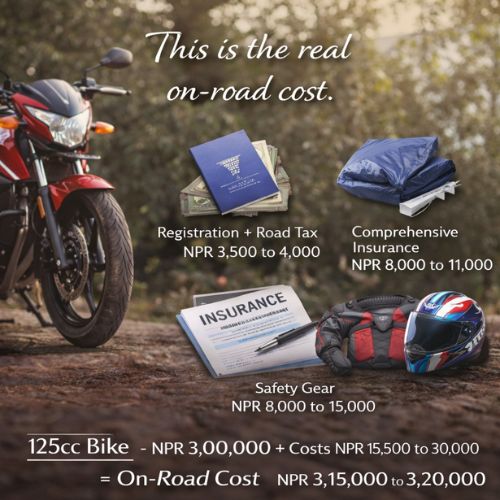
In Bagmati Province, registration and bluebook cost around NPR 3,500 to 4,000. That already includes the first-year road tax of NPR 3,000.
Now insurance. Third-party insurance is mandatory by law. But most buyers choose comprehensive insurance for a new bike. That costs roughly NPR 8,000 to 11,000.
Then comes something many people forget.
Helmet. Basic riding jacket. Rain cover. Even a decent helmet alone can cost between NPR 2,500 and 6,000. If you add basic safety gear, you are easily spending another NPR 8,000 to 15,000.
Now pause and calculate.
Before you even talk about EMI, your 3,00,000 bike is already closer to 3,15,000 to 3,20,000 in real planning.
This is the real on-road cost.
Buying a bike and a scooter on loan in Nepal? Here Is The Reality
Let us say you pay a 30 percent down payment.
That is NPR 90,000.
Loan amount becomes NPR 2,10,000. At 12 percent interest for 3 years, your EMI becomes roughly NPR 6,975 per month.
Now combine everything.
Upfront payment is not just 90,000. It is 90,000 plus around 15,000 to 20,000 in additional costs.
That means you realistically need around 1,05,000 to 1,10,000 in hand before delivery.
Then every month, for 36 months, around 7,000 goes to EMI.
If your monthly income is 35,000, this is already 20 percent of your salary before petrol and maintenance.
That is the financial picture.
Now Look at a Scooter Example
Take a 110cc scooter priced at NPR 2,50,000.
A thirty percent down payment is NPR 75,000. Loan amount becomes NPR 1,75,000.
At 12 percent interest for 3 years, EMI is around NPR 5,815 per month. Add the same registration, insurance, and safety gear costs.
Your upfront cash requirement becomes roughly 90,000 to 95,000.
Many bikers are surprised when they realize the scooter still needs close to one lakh before riding home.
The difference between a bike and a scooter is not as big as it first appears.
The Budget Mistake Most Nepali Buyers Make
They focus only on EMI. They ask, how much EMI for a 3 lakh bike in Nepal?
But EMI is only one part of the monthly pressure.
You must also consider:
Monthly petrol cost
Servicing cost every few months
Annual road tax renewal of NPR 3,000
Annual insurance renewal
If EMI, petrol, and maintenance together feel stressful, the vehicle is above your safe budget.
A loan should not create tension every month.
What You Should Consider Instead
Before finalizing any model, calculate three numbers:
- How much can I pay upfront without emptying savings?
- How much EMI can I pay comfortably even in a bad month?
- How much extra will I spend yearly on road tax, insurance, and servicing?
If the answer feels tight, reduce the vehicle segment.
A slightly cheaper bike that you can maintain properly is always better than a bigger bike that creates financial stress.
Financial comfort increases long-term satisfaction more than engine size.
Now that you clearly understand the real budget beyond showroom price, we move to the next major decision.
Petrol or electric.
Because on paper, electric looks much cheaper per kilometer. But ownership in Nepal is not decided on paper alone.
In Step 3, we will calculate 5 year cost comparison between petrol and electric in real Nepali conditions.
Step 3 – Compare Petrol vs Electric Before Finalizing
This is the most debated question in Nepal right now.
Petrol vs electric bike Nepal or which one is better petrol or electric scooter?
On social media, electric looks like the obvious winner. People show per-kilometer costs and say petrol is outdated.
But ownership is not decided by a single number.
So let us calculate calmly.
We assume you ride 25 km per day. Over 5 years, that becomes 45,625 km.
Now we compare a 110cc petrol scooter at NPR 2,50,000 and an Ather 450X electric scooter at NPR 3,85,000.
What People Think
People think electric saves huge amounts of money because electricity is cheap.
Petrol costs NPR 156 per litre. That feels expensive. On the other hand, electric charging at around NPR 10 per unit feels almost free.
So many buyers conclude that electric is always cheaper.
But this is only the running cost view.
Ownership has more layers.
Fuel vs Electricity Cost
A petrol scooter giving around 50 kmpl will consume about 912 litres over 45,625 km.
At NPR 156 per litre, fuel cost becomes roughly NPR 142,350 over 5 years.
Now let’s see the price that you have to pay for an electric one.
The charging cost over the same distance is roughly NPR 18,250. This is where electric looks very attractive.
Fuel difference alone is more than NPR 1,20,000 in 5 years.
But now we move deeper.
Maintenance Difference
Petrol scooter needs:
- Regular engine oil change
- Air filter
- Spark plug
- Periodic servicing
On average, around NPR 8,000 per year. Over 5 years, that becomes roughly NPR 40,000.
An electric scooter has fewer moving parts.
- No engine oil.
- No clutch.
- Lower routine servicing.
Estimated at around NPR 2,000 per year. So roughly NPR 10,000 in 5 years.
Again, electric looks cheaper.
But we are not finished.
Battery Replacement Reality of Electric Scooter In Nepal
Battery replacement cost in Nepal ranges widely.
The average realistic assumption is NPR 85,000.
However, brands like Ather provide 5 year battery warranty. This means in the first 5 years, you may not actually pay the battery replacement cost if used normally.
But here is the practical thinking.
If you keep the vehicle beyond the warranty period, battery replacement becomes a future cost.
Also, resale value depends heavily on battery health. This uncertainty affects long-term ownership calculation.
Road Tax and Policy
A petrol scooter pays NPR 3,000 per year in road tax.
Over 5 years, that becomes NPR 15,000.
Electric scooters currently enjoy lower or zero road tax in some policies. This reduces the cost slightly.
But tax policy can change at any given moment. Petrol tax structure is stable and predictable.
EV tax incentives depend on government policy.
Now Look at Total 5 Year Cost of Owning Petrol Scooter And Electric Bike In Nepal
Petrol scooter total estimated cost:
- NPR 2,50,000 purchase
- NPR 142,350 fuel
- NPR 40,000 maintenance
- NPR 15,000 road tax
Total around NPR 447,350
Electric scooter total estimated cost:
- NPR 3,85,000 purchase
- NPR 18,250 electricity
- NPR 10,000 maintenance
- Battery provision NPR 85,000
Total around NPR 498,250
Even without battery replacement during warranty, upfront price difference is large.
Electricity saves on daily running costs. Petrol saves on the initial purchase price.
Charging Infrastructure Reality for Electric Scooter In Nepal
If you have secure home charging, electric is practical.
If you live in a rented flat without fixed charging access, it becomes complicated.
Gogoro battery swapping is growing in Kathmandu, but still limited outside major cities.
Before buying an electric scooter in Nepal, check:
Do I have reliable daily charging access?
If charging becomes stressful, savings do not matter.
What You Should Consider Instead
If your priority is the lowest upfront cost and predictable resale, the petrol scooter remains safer.
If your priority is low daily running cost and you ride more than 25 km daily in city traffic, the electric becomes financially stronger over time.
If your daily travel crosses 35 km consistently, electric savings increase significantly.
If you plan to keep the vehicle beyond 5 years, factor in battery replacement clearly.
But remember:
Electric is not automatically cheaper.
Petrol is not automatically outdated.
The correct answer depends on:
- Your daily distance
- Your charging access
- Your comfort with long-term battery risk
- Your upfront budget capacity
Now that you understand the real 5-year cost difference, the next step becomes easier.
Because even after choosing petrol or electric, you must still answer one question.
Which brand and price range fits your budget in Nepal?
In Step 4, we will look at the latest bike and scooter prices in Nepal for 2026 and what you actually get at each price level.
Step 4 – Understand Latest Bike and Scooter Prices in Nepal 2026
After comparing petrol and electric, the next question becomes practical.
Within my budget, which brand and price range actually makes sense?
Because price difference between brands is not only about engine size. It also reflects resale value, spare parts cost, and service network strength.
Let us break it down properly.
Entry Level Segment – Around 2.1 to 2.8 Lakh
This is where most first-time buyers look.
- Hero bikes in the 100cc to 125cc range start around 2.1 lakh and go up to 2.8 lakh.
- Hero scooters also fall between 2.2 and 2.5 lakh.
These vehicles usually offer good mileage and low servicing costs. Spare parts are affordable and available in most towns.
If your priority is low purchase cost and simple daily use, this segment is financially safer.
Resale value is moderate, but not as strong as Honda’s.
Practical Middle Segment – 2.8 to 3.3 Lakh
This is the most practical range for Nepali buyers.
- Honda Shine and SP 125 fall between 2.9 to 3.3 lakh.
- TVS Raider sits around 2.8 to 3.2 lakh.
- Honda Dio, Activa, Yamaha RayZR, and Suzuki Access fall between 2.5 to 3.3 lakh.
This segment offers the best balance of:
Mileage
Maintenance
Resale value
Service network
For someone searching for the best bike for daily use in Nepal, most answers fall in this range.
Honda generally has stronger resale value.
On the other hand, TVS offers good value for the price. And Suzuki scooters are known for a smooth engine and decent mileage.
Yamaha bikes have strong build quality but slightly higher servicing costs in some areas.
If you want reliability with predictable maintenance, this is the safest segment.
Higher Segment – 3.8 to 6.5 Lakh
This includes Yamaha FZ, R15, and MT series,Bajaj Pulsar 150 to 200 series, and bikes like the Suzuki Gixxer.
Here, price increases mainly due to engine size and features.
But for daily city use, mileage drops to 35-45 kmpl in many cases. Maintenance cost increases. Insurance cost also increases due to a higher IDV.
If your daily travel distance is under 25 km in traffic, this segment may not give a financial advantage.
It suits riders who need highway performance or long-distance riding.
From a cost perspective, it is not always the most practical choice.
Electric Scooter Segment – 2.6 to 5.5 Lakh
Electric scooter price in Nepal now ranges widely.
- Yadea starts around 2.6 lakh.
- NIU ranges from 3.4 to 4.8 lakh.
- Ather ranges from 4.2 to 5.5 lakh.
- Gogoro sits between 3.5 to 4.5 lakh depending on plan.
Lower-priced EV models reduce the upfront burden but may offer smaller battery capacity.
Premium EVs like Ather offer stronger performance and longer warranties.
But the price difference is large compared to a petrol scooter at 2.5 lakh.
So electric decision depends heavily on your daily distance and charging access, as discussed earlier.
What Actually Matters More Than Price
Many buyers ask which is the best bike in Nepal. But there is no single best bike.
There is only one best match for your budget and usage.
Ask these instead:
- Does this brand have workshop in my city?
- Are spare parts easily available?
- How strong is resale value after 3 years?
- Is maintenance cost predictable?
Honda usually scores high in resale and parts availability.
TVS and Bajaj often offer strong value for price.
Yamaha and Suzuki offer solid build but sometimes slightly higher part cost.
Electric brands differ heavily in service coverage. Premium brands have better support in big cities, but rural access is still limited.
Practical Recommendation by Budget
If the budget is under 2.5 lakh:
Focus on entry level bike or scooter with low maintenance.
If the budget is 2.8 to 3.2 lakh:
This is the safest long-term ownership segment for most Nepali buyers.
If the budget crosses 4 lakh:
Make sure your daily use justifies higher fuel or insurance cost.
If considering electric above 4 lakh:
Calculate the 5-year cost carefully and confirm the charging access.
Now that you understand what price range fits your situation, the next serious decision is about payment method.
Should you buy in cash or take a loan?
Step 5 – Should You Buy in Cash or Take a Loan?
Let us imagine one clear situation.
You want to buy a 125cc bike priced at NPR 3,00,000.
You have savings, but not the full amount. The showroom offers finance. The bank also offers a loan.
Now the question is not “Can I get EMI?”
The question is “Which option keeps my total cost and stress lower?”
First, Understand What Changes When You Take a Loan
If you buy in cash, your cost is simple.
- You pay the full price.
- You pay registration, insurance, and road tax.
- After that, only petrol and maintenance remain.
No interest. No monthly obligation.
Now look at loan.
Let us say you choose a 50 percent down payment, which is common for petrol bikes in 2026 due to the loan-to-value rules.
You pay NPR 1,50,000 upfront. Loan amount becomes NPR 1,50,000.
At a 12 percent reducing balance for 3 years, EMI becomes around NPR 4,980 per month. The total interest over 3 years is roughly NPR 29,000. That 29,000 is the price of not paying full cash.
Now compare this with 30 percent down payment.
You pay NPR 90,000 upfront. Loan becomes NPR 2,10,000. EMI becomes around NPR 6,975 per month. Total interest crosses NPR 41,000.
Same bike. Same price.
But a lower down payment increases your interest by more than 10,000.
This is where many buyers underestimate the cost of “small EMI”.
Bank Loan vs Showroom Finance
Now let us assume you need financing.
Commercial banks in 2026 usually charge around 9 to 13 percent interest using the reducing balance method. Showroom finance or hire purchase companies may charge 14-18%.
The difference looks small when you hear the number.
But over three years, higher interest means you may pay 15,000 to 25,000 more in total.
Showroom finance is faster. Sometimes approval happens in one day. Banks may take 3 to 7 working days and require proper income documents.
So the real question becomes:
Are you choosing speed or lower total cost?
If you have proper income proof and a stable bank history, a commercial bank loan is financially safer.
Now Look at Your Income
Let us assume your monthly income is NPR 50,000.
An EMI of 4,980 is comfortable. An EMI of 6,975 is still manageable. But if your income is NPR 30,000, that same 6,975 feels heavy.
And remember, EMI is not your only monthly cost.
- Add petrol cost.
- Add servicing cost.
- Add insurance renewal next year.
- Add road tax every year.
Like we told you previosuly “A loan should not push you into monthly stress.”
Even though NRB allows higher debt-to-income ratios, practical comfort should keep EMI under 30 percent of your income.
The Real Decision
If you have enough savings and an emergency fund that remains safe after purchase, cash is always cheaper.
If paying full cash empties your savings completely, a partial loan with a higher down payment is smarter than a small down payment with a large EMI.
A loan should solve the mobility problem, not create financial pressure.
Choosing between cash and a loan is not about what is available. It is about how much long-term pressure you are willing to carry.
Frequently Asked Questions
How to buy a bike in Nepal step by step?
- First, decide the type based on your daily use.
- Then set your real budget, including registration, insurance, and safety gear.
- Compare petrol vs electric based on 5 year cost, not just per km fuel cost.
- Check service network and spare parts availability in your city.
- Finally decide cash or loan after calculating EMI safely.
- Buying in the wrong order creates regret later.
How to buy scooter in Nepal for daily use?
If your daily travel is under 20 km in city traffic, a 110cc petrol scooter or electric scooter usually makes practical sense. Focus on mileage in traffic, servicing cost, and resale value.
Before booking, confirm workshop availability near your home. Scooter should make daily life easier, not increase maintenance stress.
How much EMI for a 3 lakh bike in Nepal?
For an NPR 3,00,000 bike:
- With 50 percent down payment, EMI is around NPR 4,980 per month for 3 years at 12 percent interest.
- With 30 percent down payment, EMI becomes around NPR 6,975 per month.
A higher down payment reduces both EMI and total interest.
Always calculate total interest, not just the monthly EMI.
What documents are required for a bike loan in Nepal?
For a commercial bank loan, you usually need:
- Citizenship copy and photos.
- Salary slip or business income proof.
- Six months’ bank statement.
- Proforma invoice from the showroom.
- Guarantor with a citizenship copy.
Showroom finance may ask for fewer documents, but often charges higher interest.
How to register a bike in Nepal?
After payment, the dealer usually helps with registration. You must pay road tax and the bluebook fee at the transport office.
In Bagmati Province, the annual road tax for up to 125cc is NPR 3,000. Keep insurance active and renew road tax every year to avoid fines.
What is the road tax for a bike in Nepal?
For up to 125cc bikes and 110cc scooters in Bagmati Province, annual road tax is NPR 3,000.
This must be paid yearly during Blue Book renewal.
If delayed, a penalty applies. Road tax is a predictable cost and should be included in the yearly budget.
Which bike is best for daily use in Nepal?
There is no single best bike.
For most daily users, 125cc bikes offer the best balance of mileage, maintenance, and resale value. Honda Shine, TVS Raider, and similar models fall in this practical category.
For pure city traffic under 15 km daily, a scooter is often easier.
Choose based on usage, not brand hype.
Is an electric scooter worth buying in Nepal?
An electric scooter reduces fuel costs significantly.
If you ride 25 km daily and have reliable home charging, long-term savings are strong. But consider battery replacement risk after the warranty period.
If you live outside major cities where EV workshop support is limited, petrol remains safer. Electric makes sense when charging access is easy, and the daily running cost matters more than resale.
How to check the service network before buying?
- Ask how many authorized workshops exist in your city.
- Talk to the local mechanic about spare parts availability.
- Check waiting time for servicing during peak season.
- A bike with a strong service network reduces long-term ownership stress.
What mistakes should you avoid when buying a bike in Nepal?
- Choosing beyond EMI capacity.
- Ignoring mileage in traffic.
- Not checking the spare parts cost.
- Not comparing bank vs showroom finance.
- Buying based only on looks.
- Vehicle purchase is a 3 to 5-year commitment. Think long term.

Bishad Kandel has been writing for the past three years across different niches, combining creativity with research-driven insights. With a degree in Information Technology, he brings a strong background in data analysis to his work, ensuring every blog he writes is factual, engaging, and meaningful. His approach blends storytelling with evidence, making complex topics easier to understand for readers.