“Making the Constitution of Nepal Using AI” sounds funny, right?
But wait, in a matter of week, we have managed to throw the corrupt government, decide on the interim prime minister, and join the political discussion in Discord. Something that none of us had ever imagined!
Since then, most of the intellectual ones have continued to question, ‘What’s next?’ Are you guys gonna make the Constitution using ChatGPT now?

Well, then a thought came to my mind! Why not?
We do know AI can help us in sectors like education, business, and Healthcare. What happens if we take help from it in formulating a constitution?
After all, constitutions are meant to represent the people’s will, and what better way to do that than by using a tool that can analyze vast amounts of data, balance diverse perspectives, and create frameworks that could stand the test of time?
And guess what! Folks from Albania have just made AI their minister.
So, even if it’s just for the experiment, there is no harm in trying it, right?
Disclaimer: I am not trying to make fun of our current constitution; this blog is written with the context of what if.
What Steps Did I Follow?
As a Nepali, I know we have different marginalized groups that have faced discrimination in the past.
The constitution should carry out its wishes as well. Furthermore, many people in nepal also live below the poverty line and in a way should fulfill their wishes as well.
So the first thing I did was research a bit about Nepal’s structure. (If only I had studied social seriously during my classes, none of this would have happened.)
For this specific challenge, I used two platforms: ChatGPT and Perplexity AI.
Step 1: Collecting The Data for The ChatGPT
Well, who better to ask about the data that it needs than Chat GPT itself, right?
So, the first thing I did was I simply asked, “Can you create a Constitution?“. Well, it’s not a surprise that it said yes!
Then I asked, “What data do you require to draft a fair constitution that promotes equality and helps marginalized and poor people in the country, while also avoiding problems among the general population, and encouraging youth to stay in the country? Now let me know what things you require, and I will provide you with all the data you require.“
Here is the list of questions it asked:

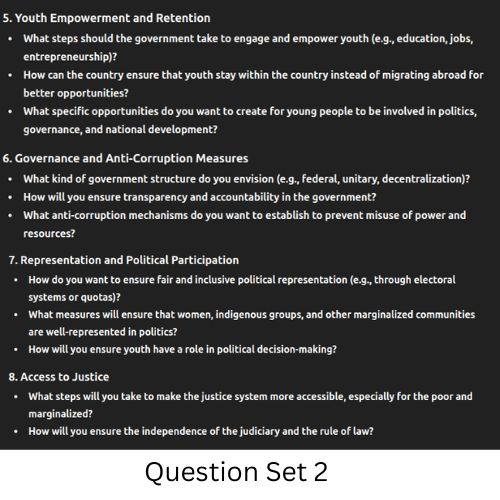
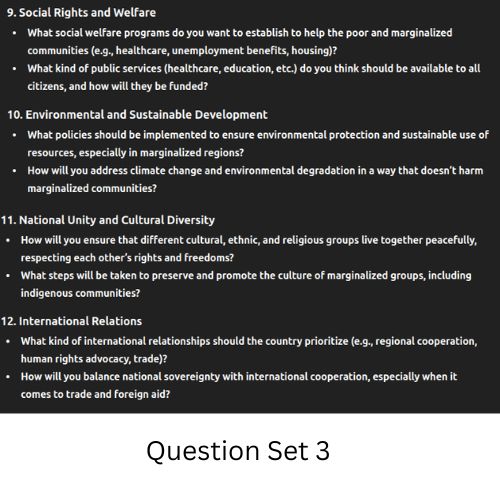
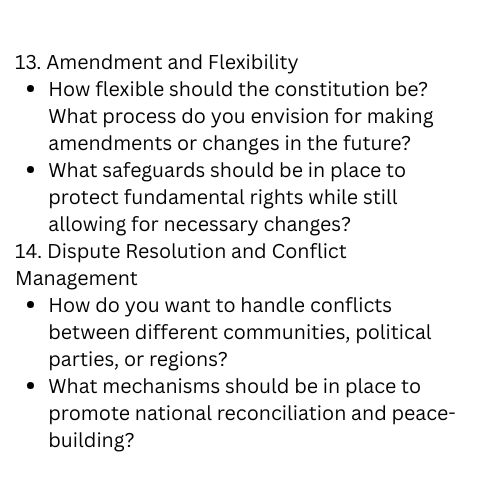
Now, I was in a dilemma: should I answer this myself or let ChatGPT handle this as well? Then, I remembered that this whole experiment should be purely based on AI.
So, I copied the whole thing and opened a new chat.
Now, if you’ve been using AI for quite a long time, you might know that you need to set an actor. It means you can make ChatGPT respond in a certain way so that it won’t go out of context.
For this, I made ChatGPT, the parliament member of Nepal. Here is the prompt I used:
“Act as the parliament member of Nepal and answer all these questions. The answers you are gonna give must be detailed. It should cover everything. If you want, you can research on the Internet as well, or from research papers that have been published so far.“
Just to be safe, I also used perplexity.ai, which gives out real-time data by searching the Internet.
Step 2: Feeding The Data
After about 3 minutes, I got all the data. I just gave it to ChatGPT and asked it to read and analyze it thoroughly.
Afterwards, I directly asked it to draft one for me.
However, ChatGPT missed out on most of the data I provided. So, this time around, I asked it to remake the constitution using all the data I offered.
Then, it gave me my second draft.
Step 3: Review and Tweaking
After getting the draft, I read it, and I realized the flaw ChatGPT had. They were:
- It wasn’t descriptive enough.
- It wasn’t more people-focused
So, I tried again and told GPT to give more power to the general public.
If you wanna read what Chat GPT gave, here it is in pdf version:
Positive Aspects Of The Draft
1. Citizens Can Make Laws (Article 94A)
What it says:
If 1% of voters sign a petition for a new law, Parliament must discuss it. If they ignore it, people can vote on it directly.
Why it helps people:
Citizens don’t need to wait for politicians. They can create laws themselves.
2. Remove Bad Leaders Anytime (Article 94B)
What it says:
If 25% of voters sign a petition, there will be a special vote to remove the leader. If most people vote YES, that leader is fired and replaced.
Why it helps people:
Citizens can kick out corrupt leaders without waiting for the next election.
3. Public Vote for Big Changes (Article 94C)
What it says:
Any major change to the constitution or people’s rights must be approved by the public through a vote.
Why it helps people:
Prevents politicians from secretly changing laws that affect everyone.
4. Citizens Control Part of the Budget (Article 94D)
What it says:
5% of local government money must be spent on projects chosen directly by citizens. Public meetings are required for big projects.
Why it helps people:
People decide how some of their tax money is used.
5. Government Must Respond to Petitions (Article 94E)
What it says:
If enough people sign a petition online, the government must respond publicly within 60 days.
Why it helps people:
The government cannot ignore citizens.
6. Citizens Review Laws (Article 94F)
What it says:
Ordinary citizens are chosen to review new laws before they are passed.
Why it helps people:
Prevents unfair laws that only benefit the powerful.
7. All Government Information Must Be Public (Article 94G)
What it says:
The government must publish budgets, contracts, politicians wealth, and meetings openly online.
Why it helps people:
Makes corruption easy to see and hard to hide.
8. Protect Whistleblowers (Article 94H)
What it says:
People who report corruption are protected and rewarded.
Why it helps people:
Encourages people to report wrongdoing without fear.
9. Stop Secret Deals (Article 94I)
What it says:
Leaders must record all meetings with lobbyists and cannot take gifts or bribes.
Why it helps people:
Citizens can see who is influencing their leaders.
10. Fair Hiring for Government Jobs (Article 94J)
What it says:
Important government jobs are filled through open competition and public interviews.
Why it helps people:
Qualified people get jobs, not just friends of politicians.
11. Time Limits for Leaders (Article 94K)
What it says:
The Prime Minister can only serve two terms. Ministers and local leaders also have term limits.
Why it helps people:
Prevents leaders from holding power forever.
12. Catch Hidden Wealth (Article 94L)
What it says:
If leaders have suspicious wealth, they must prove it is legal or lose it.
Why it helps people:
Stops politicians from stealing public money.
13. Protect Indigenous Communities (Article 94M)
What it says:
Big projects on indigenous lands must get local approval first.
Why it helps people:
Protects communities from being forced out or exploited.
14. Protect Protesters (Article 94N)
What it says:
Protesters cannot be spied on, attacked, or unfairly punished.
Why it helps people:
People can protest safely without fear of violence.
15. Fair Elections with Proportional Representation (Article 73)
What it says:
- 60% of seats are elected directly through First-Past-the-Post (FPTP).
- 40% of seats are filled through Proportional Representation (PR) with open list.
- At least 10% of PR seats must go to youth under 35.
- Women, Dalits, Madhesis, Muslims, and others must also be included fairly.
Why it helps people:
- Smaller parties and minority groups also get a voice.
- Gives young people and marginalized groups fair representation.
- Prevents only big parties from controlling Parliament.
- Helps in transparency as the public will be able to view the open list as well.
Should We Make The Constitution Through AI?
Heck NO!!!
Besides the above point, most of the other points lack clarity. In fact, it even lacks the basic understanding of our country.
Additionally, the voices of everyone should be heard as well. Even after giving the whole data, it still lacked the understanding of our unique culture, our unique diversities and at times even our unique landscapes.
Furthermore, while making the constitution, lawmakers should also consider points that are a threat to national security, which means some other data should also be analyzed in secret. That data can’t be revealed to the external software.
But we can use it to understand different articles of our current constitution. We can copy and paste the article to understand what it actually means. (That’s what I have been doing!)
However, with that being said, it does make me wonder, if this only took a span of a few hours, then why did we have to wait 8 long years for the new constitution?

Bishad Kandel has been writing for the past three years across different niches, combining creativity with research-driven insights. With a degree in Information Technology, he brings a strong background in data analysis to his work, ensuring every blog he writes is factual, engaging, and meaningful. His approach blends storytelling with evidence, making complex topics easier to understand for readers.